Buffer zones
Batteries on the quay are a quicker, cheaper fix for weak port grids than new cables, but only if regulators let ports earn from the power they store.
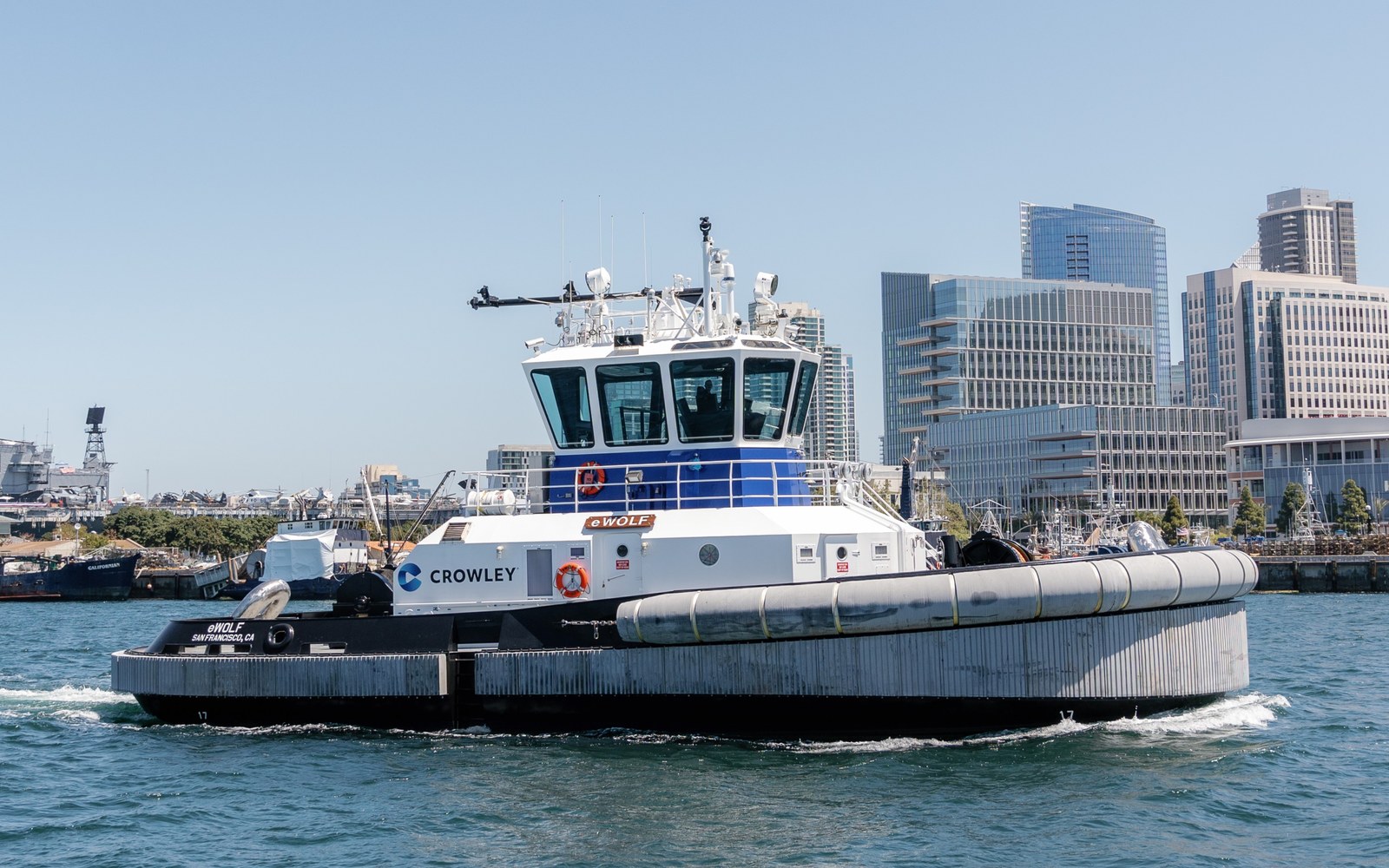
On 9 August 2023, Crowley and the Port of San Diego broke ground on a charging station for the eWolf, the first fully electric tug in the United States. At its core sit two shipping containers from Corvus Energy, each holding almost 1.5 MWh of batteries. They fill from the grid off peak and empty into the tug when it returns, so the tug charges fast and the community grid barely notices.
From Singapore to southern Sweden, ports are putting batteries between the grid and the berth. A battery turns a small, steady grid connection into a large, brief one, and for a port facing a long wait for a new substation it is often the quickest way to electrify. Our guide to electric ferries and port charging explains why turnaround time sets the power a berth needs.
The hardware has become cheap. BloombergNEF's annual survey, published in December 2025, put the average lithium ion pack at a record low of US$108 per kWh, and packs for stationary storage at US$70 per kWh, 45% below the year before. The rules have moved more slowly. Whether a quay battery pays now depends on what the port may do with it: sell grid services, trade stored power and avoid paying network charges twice. On that, Europe is patchy.
Small cables, big chargers
The case is clearest for ferries and tugs, which need a lot of energy in a short window. San Francisco Bay Ferry's first universal charging float, one of two under a US$47 million contract and due at the Downtown San Francisco Ferry Terminal in 2027, combines 5 MW of charging capacity with a 1.5 MWh battery and the power conversion equipment on the float itself. WETA, which runs the service, says the storage will lower peak demand and operating costs, as we reported when the first float's keel was laid.
Tugs pose the same problem. AYK Energy is supplying 4,838 kWh battery systems for each of four fully electric Svitzer tugs being built at Cochin Shipyard in India, with Kongsberg Maritime providing the shore charging equipment. Refilling a pack that size between jobs from an ordinary harbour supply is slow; a buffer on the quay, like Crowley's in San Diego, makes it fast.
Shaving the crane peaks
Container terminals use batteries differently. Cranes and prime movers draw sharp, irregular peaks, and utilities bill for the peak. On 13 July 2022, PSA and Singapore's Energy Market Authority announced a 2 MW / 2 MWh battery at Pasir Panjang Terminal, the first energy storage system in Singapore, due to start in the third quarter of that year. It discharges when a surge in demand is forecast. PSA said the wider smart grid system could raise the energy efficiency of port operations by up to 2.5% and cut about 1,000 tonnes of CO2 equivalent a year.
San Diego went further at its Tenth Avenue Marine Terminal, where a microgrid with a 2.7 MWh battery and 700 kW of solar went online in early 2024, paid for by a US$4.9 million California Energy Commission grant. The port expects to save about 60% a year on the terminal's electricity costs and keep critical systems running for about four hours in an outage.
In Europe, Trelleborgs Hamn in southern Sweden signed in January 2026 for a 4 MWh battery from Takorama Elteknik, due in service this year. It will buy power when demand and prices are low and release it when large ships connect to shore power, easing the load on the local grid ahead of the EU shore power requirements that start in 2030.
| Battery at the berth | Figure |
|---|---|
| PSA, Pasir Panjang Terminal, Singapore (2022) | 2 MW / 2 MWh, also sells grid services |
| San Francisco Bay Ferry charging float (first due 2027) | 5 MW charging, 1.5 MWh battery, US$47 million for two floats |
| Crowley eWolf station, San Diego (ground broken 2023) | Two Corvus containers, almost 1.5 MWh each |
| Tenth Avenue Marine Terminal, San Diego (online 2024) | 2.7 MWh battery, 700 kW solar |
| Trelleborgs Hamn, Sweden (signed 2026) | 4 MWh for shore power peaks |
| Four Svitzer electric tugs (AYK Energy) | 4,838 kWh on board each |
| Stationary storage pack price, 2025 | US$70 per kWh, 45% down on 2024 |
Cheaper than waiting
The alternative is slow. In Rotterdam, TenneT's waiting list for grid connections in the port area grew from 426 MW to 2,068 MW in two years, and the new 380 kV Europoort substation meant to relieve it is due in 2032, three years after the AFIR deadline. Our report on grid connections and the 2030 shore power deadline found that the substation, not the berth, sets the pace.
A battery cannot replace that substation. It can let a port electrify ferries, tugs and cranes years before the substation arrives, on the connection it already has. At US$70 per kWh, the packs for a 4 MWh system come to roughly US$280,000. Conversion equipment, installation and controls add more, but the total sits in a different league from grid programmes such as Barcelona's, which the port puts at more than €200 million.
Who gets paid
The sums improve sharply when a battery does more than one job. PSA's system shows how: when it is not managing crane peaks, it sells ancillary services to the grid through Singapore's National Electricity Market and earns revenue. A battery that only shaves peaks sits idle much of the day; one that also sells balancing services and shifts power from cheap hours to dear ones earns several times over.
EU law allows this in principle. The Electricity Directive, (EU) 2019/944, requires Member States to ensure that active customers who own storage may provide several services at once and are not charged twice, network charges included, for stored electricity kept on their premises or used for flexibility services to system operators.
Practice lags the text. A Joint Research Centre review of how Member States have applied the Commission's 2023 recommendation on energy storage, reflecting the position in April 2025, found that storage still faced double network charges in Denmark and Finland, and discriminatory or inconsistent charges for some technologies in 13 Member States. Nine, Malta among them, applied full energy taxes and levies to storage with no evidence that double taxation had been addressed. For grid services beyond frequency control, only four Member States paid storage on a level playing field.
The case against
Sceptics have fair points. Batteries wear out, and a battery that shaves peaks, charges tugs and trades power cycles hard, so stacking revenue also shortens its life. Conversion equipment, installation, controls and eventual replacement are not cheap, and a port must fund them before any savings appear.
Fire is the second worry. Lithium ion cells can fail violently, and a quay is crowded with people, vehicles and fuel. Crowley's station carries its own fire detection and suppression. EMSA, which published guidance on battery safety on board ships in November 2023 and updated it in November 2025, notes that no international regulatory instrument yet covers the safety of batteries in ships. Shore installations fall to national rules, which vary.
The weightiest objection concerns large ships. A container or cruise ship on shore power draws several megawatts for many hours. PSA Antwerp's installation at Europa Terminal is rated at 7.5 MW and comes with an upgrade of the terminal's high voltage grid connection. A 2 MWh battery would carry that load for about a quarter of an hour, and Barcelona puts its whole port's power need at 80 to 90 MW. Batteries can smooth such loads. They cannot supply them.
The verdict
For short, sharp loads such as ferries, tugs and cranes, a battery on the quay is the fastest and cheapest route to electrification on a weak grid, and Singapore and San Diego show it works. For ships that sit at berth all day, it complements grid investment and buys time while the cables are laid.
What would tip the sums is regulation. National regulators should treat port batteries as storage assets: no double network charges or taxes, open access to balancing and local flexibility markets, and a clear right to supply ships and tenants from stored power. The Directive already points that way, so most of the fix needs no new EU law. Port grids are a core theme at DTF Barcelona 2027.
Ports can already afford the batteries; regulators still have to let them earn.
The views expressed are the author's own. DTF Maritime News publishes opinion and analysis from people working on port electrification, alongside its news reporting.