IEMA calls for IMO carbon revenue to fund global port electrification
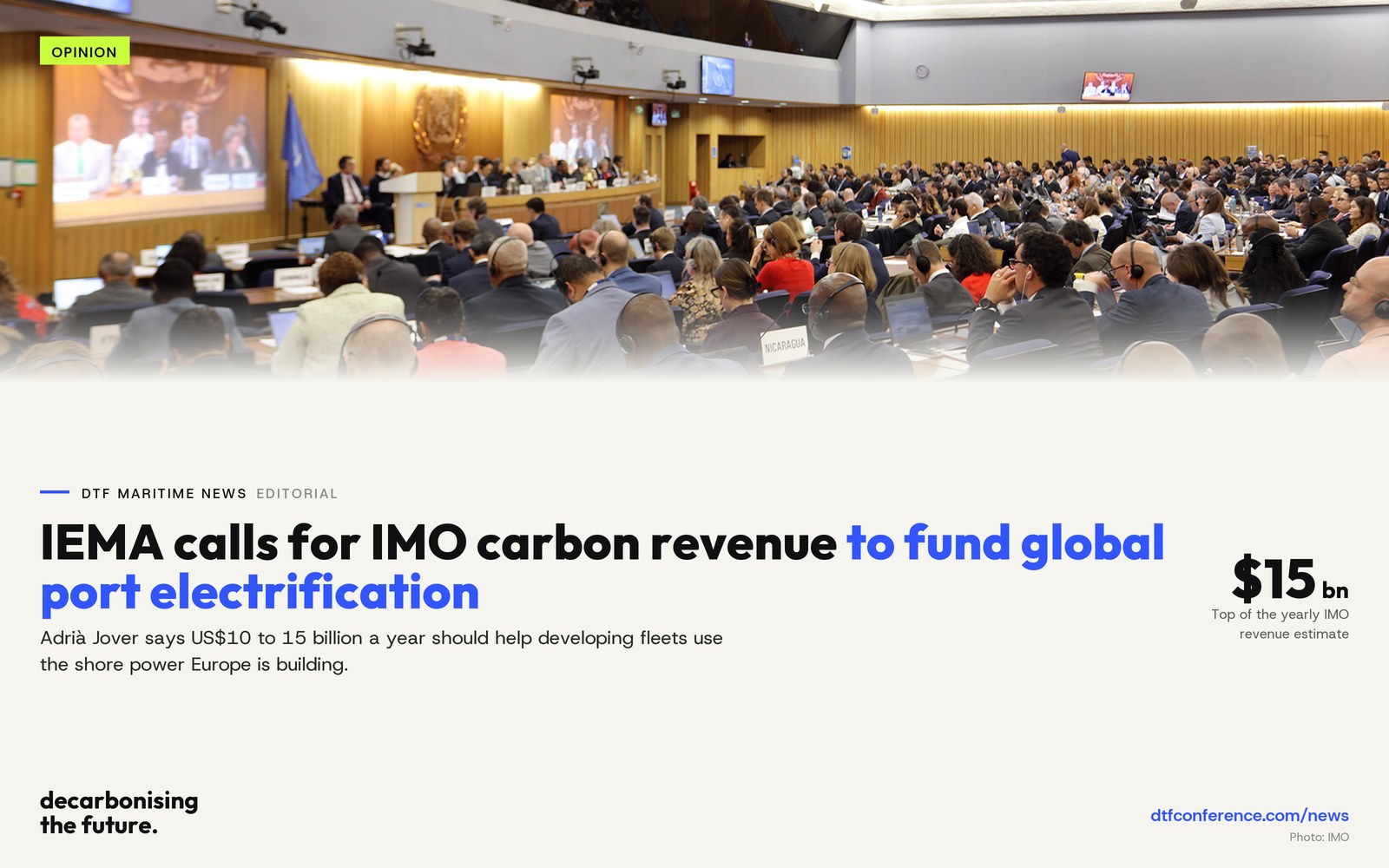
The International Electric Marine Association (IEMA) has called for carbon revenue from the International Maritime Organization's planned Net-Zero Framework, estimated at US$10 to 15 billion a year, to fund port electrification and cleaner ships in developing economies. Its president and founder, Adrià Jover, set out the case on 4 November 2026, warning that the hundreds of millions of euros Europe is spending on shore power could go underused if visiting fleets cannot afford to connect.
Empty sockets
The logic of shore power is simple. A ship at berth switches off its engines and draws electricity from the grid, cleaning the air of the port and the city around it. EU rules are now forcing the main ports to install the connections. But a socket is only useful if the ship can use it. Fitting a vessel for shore power, adding batteries or building an electric ship costs money, and for many owners in developing economies that money is not there.
Mr Jover's point is that the success of Europe's investment will be judged by how many ships actually connect, not by how many connections are built. A gleaming plug that no visiting ship can use is a stranded asset, not a climate policy.
Two speeds, one ocean
The risk he describes is a split fleet. Wealthy markets modernise, while older and dirtier ships carry on trading wherever the rules are loosest and the margins thinnest. Emissions are moved, not removed. The heaviest costs of the transition land on the countries least able to bear them, while the most polluting ships stay in their waters.
"A climate solution that leaves parts of the world behind is not a solution at all," Mr Jover writes. Shipping is, after all, the most global of industries, and its pollution follows it, as he notes, "because maritime emissions don't stop at the border."
The money is coming, in theory
The proposed fix is already on the table. The IMO, shipping's global regulator, is due to consider its Net-Zero Framework again in December. It would set emission limits for international shipping and put a price on emissions above them. Mr Jover estimates the mechanism would raise US$10 to 15 billion a year, and governments have reportedly agreed that the money should go first to the transition needs of developing countries: zero emission vessels, clean energy supply, resilient trade infrastructure and port electrification.
"This December, the EU must push the IMO to adopt a robust Net-Zero Framework," he argues.
Self interest, well understood
The case is not pure altruism. If carbon revenue helps owners in poorer regions upgrade their ships, those ships stay competitive on European trade lanes, and they arrive able to use the shore power Europe has paid for. Europe's ports get a return on their quays; developing fleets get a route into the low carbon economy. Both sides gain from the same plug.
| The argument in brief | |
|---|---|
| The problem | Europe is building shore power faster than many visiting fleets can afford to use it |
| The risk | A two speed fleet that moves emissions to other regions instead of cutting them |
| The measure | Ships actually connected, not connections installed |
| The fix | IMO Net-Zero Framework revenue, estimated at US$10 to 15 billion a year |
| The ask | The EU should push for a strong framework at the IMO in December |
What it means for ports
For port authorities, the lesson is to plan for usage, not only for compliance. The early successes, such as Aarhus with its first container ship on shore power and Seyðisfjörður with the ferry Norröna, are cases where the ships and the quay were prepared together. Barcelona, home to IEMA and host of DTF PortFocus in 2027, is one of the ports where that question will be tested on a very busy quay.
"Every barrier removed moves the entire ocean economy forward, ensuring no fleet is left without a place to plug in," Mr Jover concludes. Europe has built the sockets. Whether the world's ships can reach them is a question for December.
Read more on Aarhus plugging in its first container ship, on Norröna at Seyðisfjörður, and on DTF PortFocus Barcelona 2027.


