Lloyd's Register launches Supply Chain Resilience service to keep cargo moving when trade routes fail
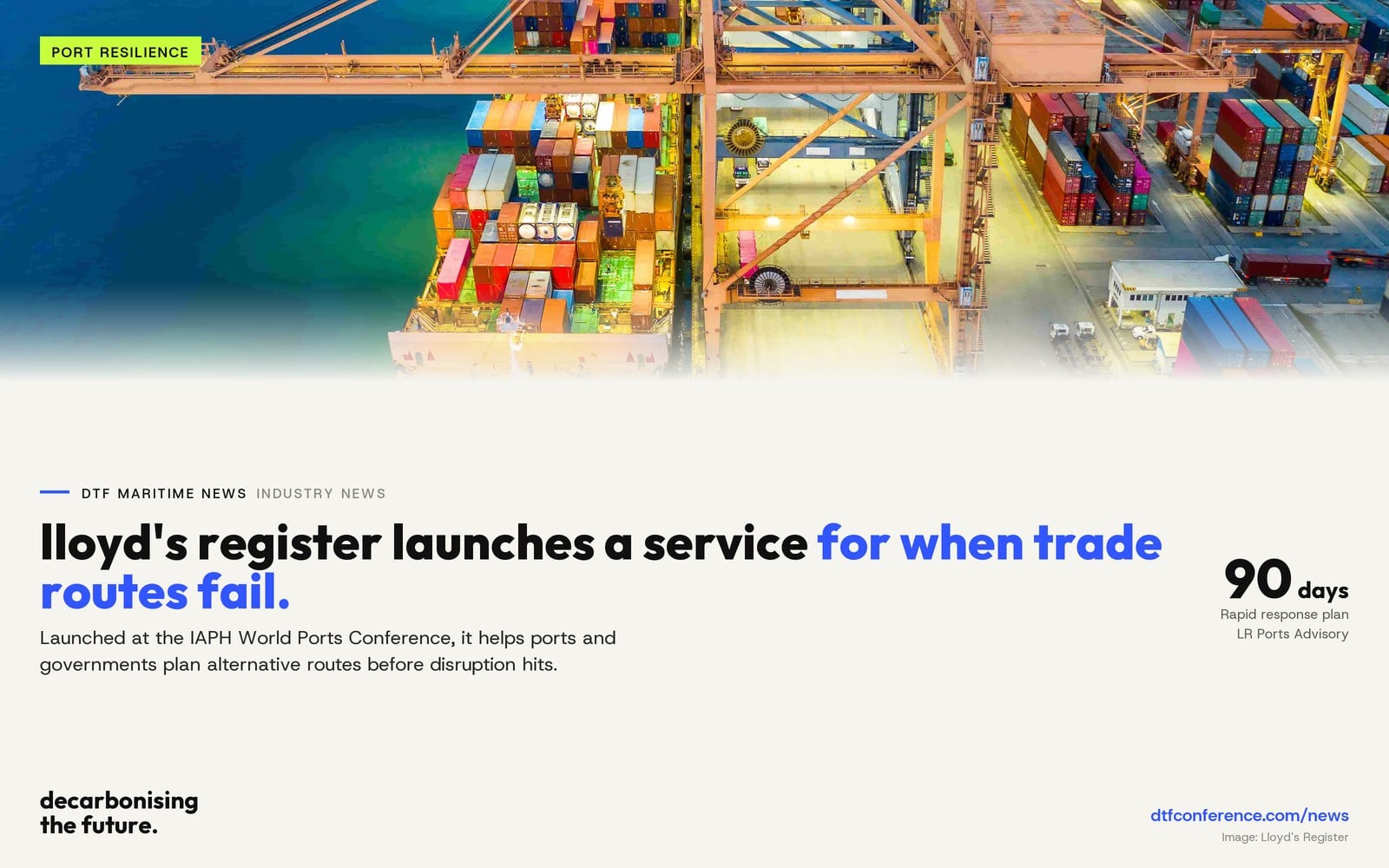
When a trade route fails, the first question is where the cargo goes next. The harder questions are whether that alternative port has the capacity, whether its road and rail links can carry the extra load, and how long it takes to switch. Lloyd's Register has launched a new service built around those questions.
LR Advisory unveiled its Supply Chain Resilience service on 4 November 2026 at the IAPH World Ports Conference in London. It is aimed at ports, governments and logistics operators that need to keep critical cargo moving when geopolitical shocks, congestion, extreme weather or infrastructure failures cut established routes.
At a glance
| LR Supply Chain Resilience service | |
|---|---|
| Provider | LR Advisory, Lloyd's Register |
| Launched | 4 November 2026, IAPH World Ports Conference, London |
| Clients | Ports, governments, logistics operators |
| Covers | Ports, airports, road borders and rail connections |
| Short term | Response plan for the first 0 to 90 days, structured at 30, 60 and 90 days |
| Long term | Corridor diversification and infrastructure planning over 3 months to 5 years |
| Priority cargo | Food, medicines, energy supplies, industrial inputs and exports |
How it works
- Map the network: the service looks at the whole chain, not one port, and shows where pressure at one gateway is likely to create a bottleneck somewhere else
- Compare the alternatives: other ports and combinations of sea, air and land transport are tested on cost, capacity, delay, service and risk
- Plan the first 90 days: a response plan sets out alternative routing, which cargo moves first, the triggers for diverting, surge capacity and operating rules
- Protect what matters most: essential and time sensitive cargo is prioritised, with sea and air, sea and land, and air and land options assessed, including bonded and cross border routes where feasible
- Build in resilience: over the longer term, the service looks at diversifying corridors and investing in dry ports, inland logistics hubs and rail connected freight nodes so that no single gateway or chokepoint carries the whole load
Triggers, not predictions
The service comes from the Ports Advisory practice headed by Kamran Ul Haq, Senior Vice President and Global Head of Ports Advisory at Lloyd's Register and a speaker at DTF. His point is a practical one. Moving cargo to another port is rarely a simple swap: capacity, inland links, border processes, cost and availability all have to line up. The aim is to know those limits in advance and to agree the triggers for action before a disruption spreads through the network, rather than to forecast where the next one will come from.
Why it matters for ports
Recent years have shown how quickly a closed strait, a blocked channel or a failed bridge can push ships onto unfamiliar routes and into ports that were not planned for them. For port authorities, that turns resilience into an infrastructure question: berths, yard space, rail and road capacity, and increasingly the power supply at the quay.
The same planning that prepares a port to take diverted cargo also shapes its energy transition. A port that may need to handle surge traffic needs a grid connection, shore power and electrified equipment sized for that peak, not only for an average day. Kamran's Ports Advisory practice covers both resilience and decarbonisation, and the two are increasingly planned together.
More on port infrastructure and planning is in Shore power and OPS.
The best time to test the backup route is before you need it.