Norröna plugs in at Seyðisfjörður as Iceland's ferry port switches on shore power
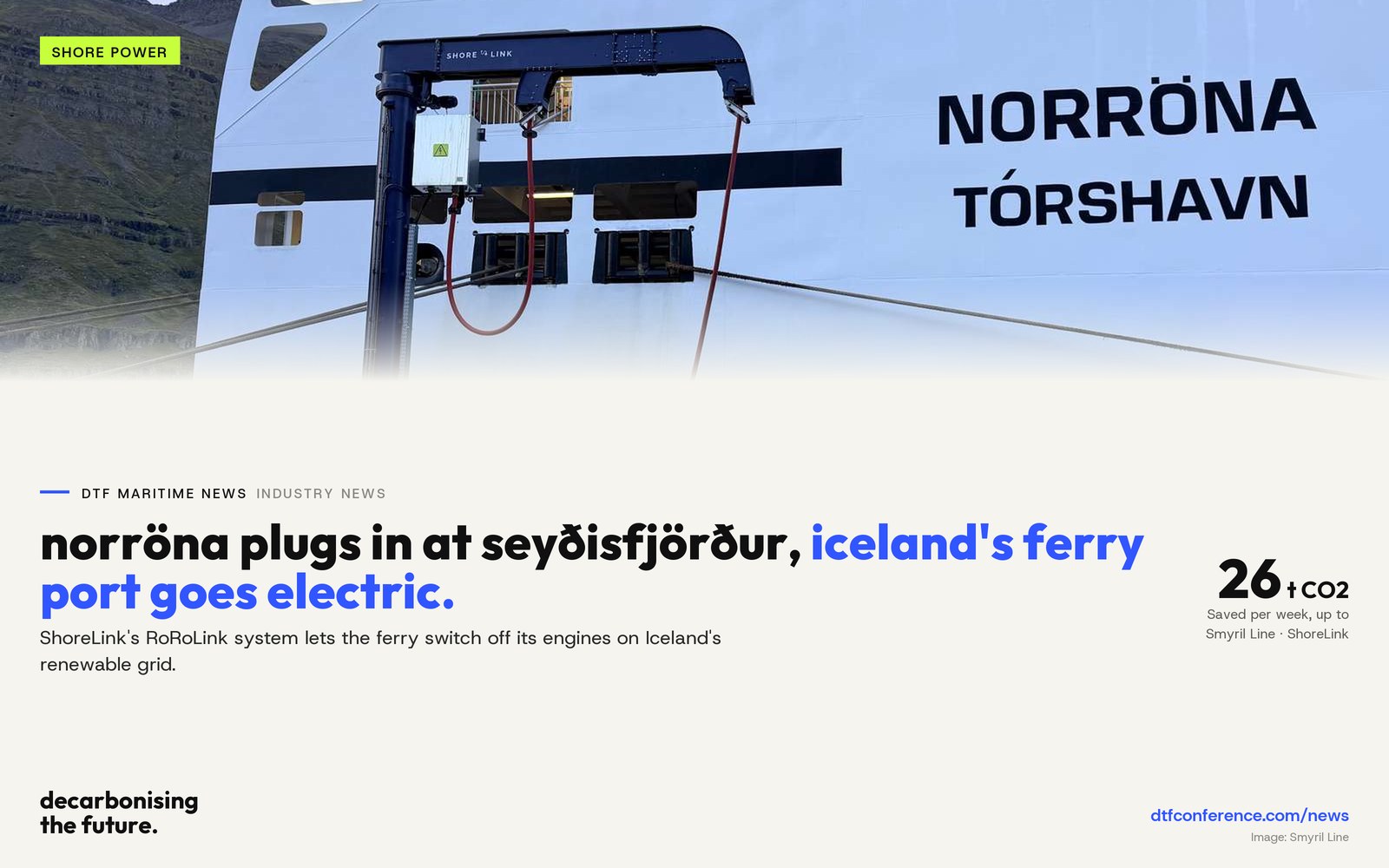
The only car ferry linking mainland Europe with Iceland now switches off its engines when it reaches port. Smyril Line's Norröna has been connected to shore power at Seyðisfjörður, its Icelandic terminal on the country's east coast, with the system formally opened on 30 September 2026.
Norröna calls at Seyðisfjörður every week for eight months of the year on its North Atlantic route from Denmark through the Faroe Islands. In the shoulder seasons it stays alongside for more than a day and a half, which makes the berth one of the best places on the route to cut emissions. Smyril Line expects to save 7 to 8 tonnes of fuel and up to 26 tonnes of CO2 every week the ship is plugged in.
At a glance
| Seyðisfjörður shore power | |
|---|---|
| Ship | Norröna, ro pax ferry operated by Smyril Line |
| Port | Seyðisfjörður, Ports of Múlaþing, Iceland |
| Shore side | ShoreLink RoRoLink Fixed cable management system |
| Ship side | ShoreLink connection cabinet, onboard system designed and installed by ETV |
| Engineering | EFLA |
| Cost | ISK 95 million, mostly from the Múlaþing port fund, with ISK 2.6 million from the state Energy Fund |
| Savings | 7 to 8 tonnes of fuel and 22 to 26 tonnes of CO2 a week |
| Power | Iceland's renewable grid |
| In operation | September 2026 |
Clean power at the plug
Shore power is only as clean as the grid behind it, and Iceland's electricity comes almost entirely from hydro and geothermal sources. Every hour Norröna spends plugged in at Seyðisfjörður replaces diesel from its auxiliary engines with renewable power, and removes engine noise, vibration and exhaust from a small town that sits right next to the quay.
Over a full eight month season, the weekly figures add up to roughly 900 tonnes of CO2 avoided, based on DTF's estimate from the operator's numbers. For the municipality of Múlaþing, the project is described as the first step in electrifying its ports.
Built for a ro ro berth
Connecting a ro pax ferry is a different job from connecting a cruise ship. The ship berths at a ramp, vehicles and trucks move across the quay during the call, and the cable has to reach a connection point high on the hull without getting in the way. ShoreLink supplied both ends of the link: the RoRoLink Fixed gantry on the quay, which carries the cables up to the ship, and the connection cabinet on board. The Faroese company ETV designed and installed the ship's electrical system for shore power.
Why ro ro and ro pax matter
Most shore power so far has been built for cruise ships and container ships, and that is also where regulation points. In the EU, AFIR requires the main ports to supply shore power to large container and passenger ships from 2030, and FuelEU Maritime requires those ships to use it. Ro pax ferries fall under the passenger ship rules. Ro ro cargo ships, car carriers and many other vessel types do not.
Yet ro ro and ro pax ships are some of the easiest vessels to electrify at berth. They run on fixed schedules, call at the same berths week after week, and often spend long hours alongside. A connection built once is used dozens of times a year by the same ship, and the investment is far easier to plan around than a berth that serves a different visitor every day. Norröna shows that the technology is ready even at a small port at the edge of the North Atlantic. Extending shore power to every regular liner service, not only the vessel types that regulation covers today, is where the next large cut in port emissions will come from.
More on shore power at ferry and ro ro berths is in Shore power and OPS.
One ship, one berth, every week. That is how regular routes go electric.