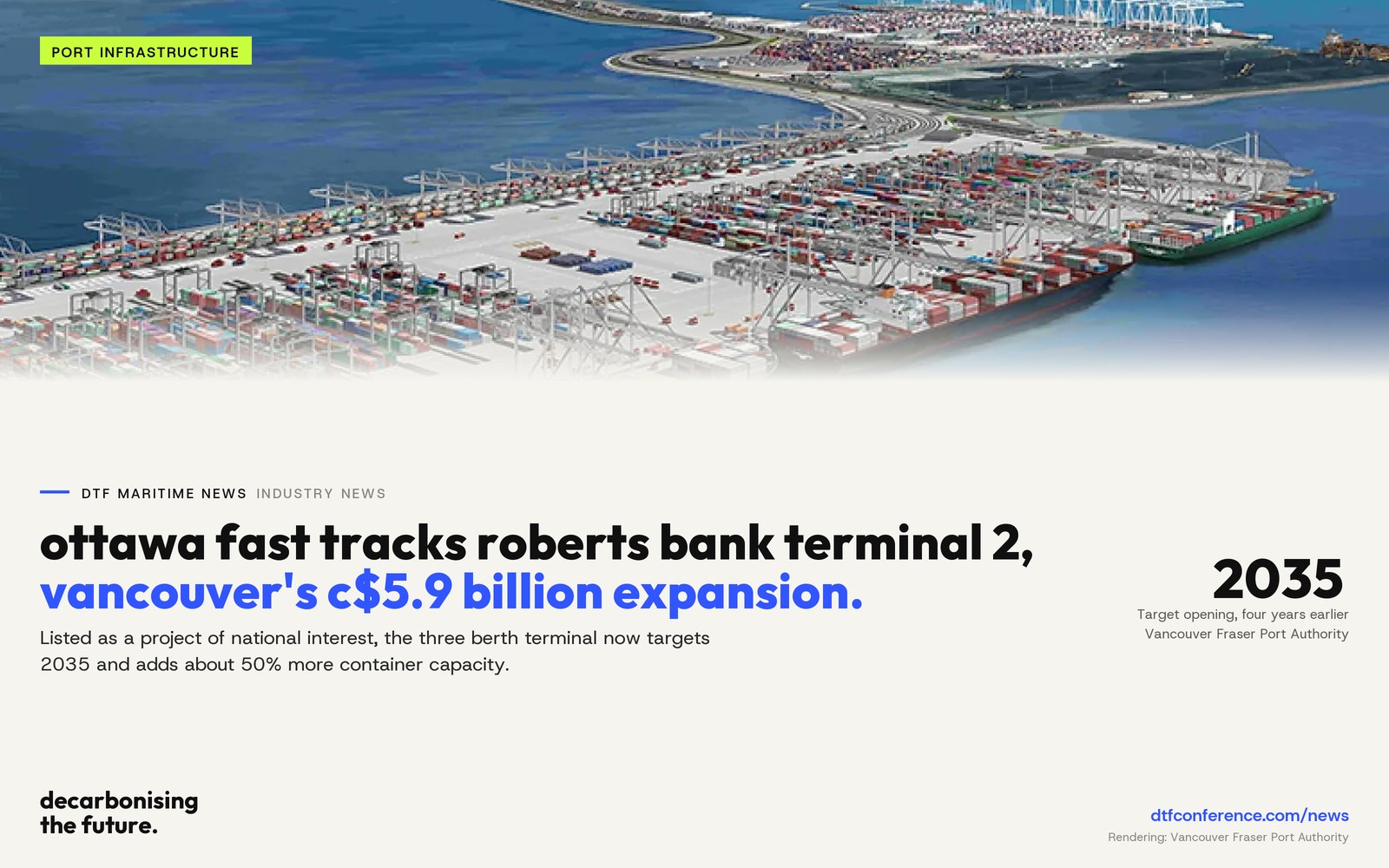
Canada's largest port is getting its next container terminal on a faster track. The federal government has listed Roberts Bank Terminal 2 as a project of national interest under the Building Canada Act, with the aim of opening the terminal in 2035, up to four years earlier than the previous target of 2039.
The three berth terminal, to be built off the coast of Delta in British Columbia by the Vancouver Fraser Port Authority, is estimated at C$5.9 billion before financing. It would add about 2.4 million TEU a year, lifting container capacity at the Port of Vancouver by around 50%.
At a glance
| Roberts Bank Terminal 2 |
|---|
| Location | Roberts Bank, Delta, British Columbia |
| Proponent | Vancouver Fraser Port Authority |
| Preferred construction partner | TerraMarine |
| Layout | Three container berths on a new marine terminal, linked by an expanded causeway |
| Capacity | About 2.4 million TEU a year, around 50% more container capacity at the port |
| Estimated cost | C$5.9 billion, excluding financing |
| Investment decision | Targeted by mid 2027 |
| Operations | Targeted for 2035, previously 2039 |
| Status | Listed as a project of national interest, 30 October 2026 |
What the listing changes
Roberts Bank Terminal 2 was approved by Ottawa in 2023, subject to 370 legally binding conditions, and later received its provincial environmental certificate. The national interest listing does not remove those conditions. It is meant to give the project upfront certainty on the federal authorizations it still needs, so the port authority can move towards a final investment decision by mid 2027. It is the second project listed under the Building Canada Act.
Ottawa's case is about trade capacity. The government says the port is nearing its container limit, and estimates that without new capacity, Canadians could face C$800 to 900 million a year in extra shipping costs from as early as 2031. It expects the terminal to support around 17,000 jobs and up to C$100 billion in annual trade.
The sustainability side
The terminal sits in one of the most sensitive marine areas on the West Coast, next to the Fraser River estuary and in habitat used by the endangered Southern Resident killer whales. The environmental elements tied to the project and the announcement include:
- Binding conditions: the 370 conditions from the 2023 approval stay in place, including measures on underwater noise and the timing of container ship departures to protect the whales
- Marine protection: nearly C$2 billion in federal funding announced alongside the listing for fish and fish habitat, Pacific salmon, marine mammals and species at risk
- Underwater noise: a new interim objective to hold underwater noise in the whales' critical habitat at 2023 levels, and an agreement with BC Ferries to cut underwater radiated noise from its vessels in that habitat by 50% by 2036
- Shore power: the terminal design includes shore power connections at its berths, extending the port's existing shore power programme, which already serves cruise ships at Canada Place and container ships at other terminals
- Rail first: on terminal intermodal rail yards are designed to move a large share of boxes by train rather than by truck
- Indigenous partnership: 27 Mutual Benefit Agreements with Indigenous communities covering training, jobs and procurement
Not everyone is convinced. Tsawwassen First Nation has given its consent with conditions, and its next priority is a breach in the Roberts Bank causeway to open up more habitat for juvenile salmon. Conservation groups argue that no mitigation can offset the risk to the whales and have said they will keep opposing the project.
Why it matters for shore power
A new container terminal opening in 2035 will serve a fleet in which shore power is becoming standard. Large container lines have been fitting high voltage shore connections for years, and California already requires container ships to plug in at berth. The berths at Roberts Bank Terminal 2 will be judged on how much of that capacity they can actually deliver from day one, and on whether the local grid connection is sized for three large ships at once.
More on shore power in North America is in Shore power and OPS.
Half again as much container capacity, four years sooner, with the whales and the salmon still part of the deal.