Canopy Power and FSC plan more than 50 MW of floating solar across Australia on Ocean Sun technology
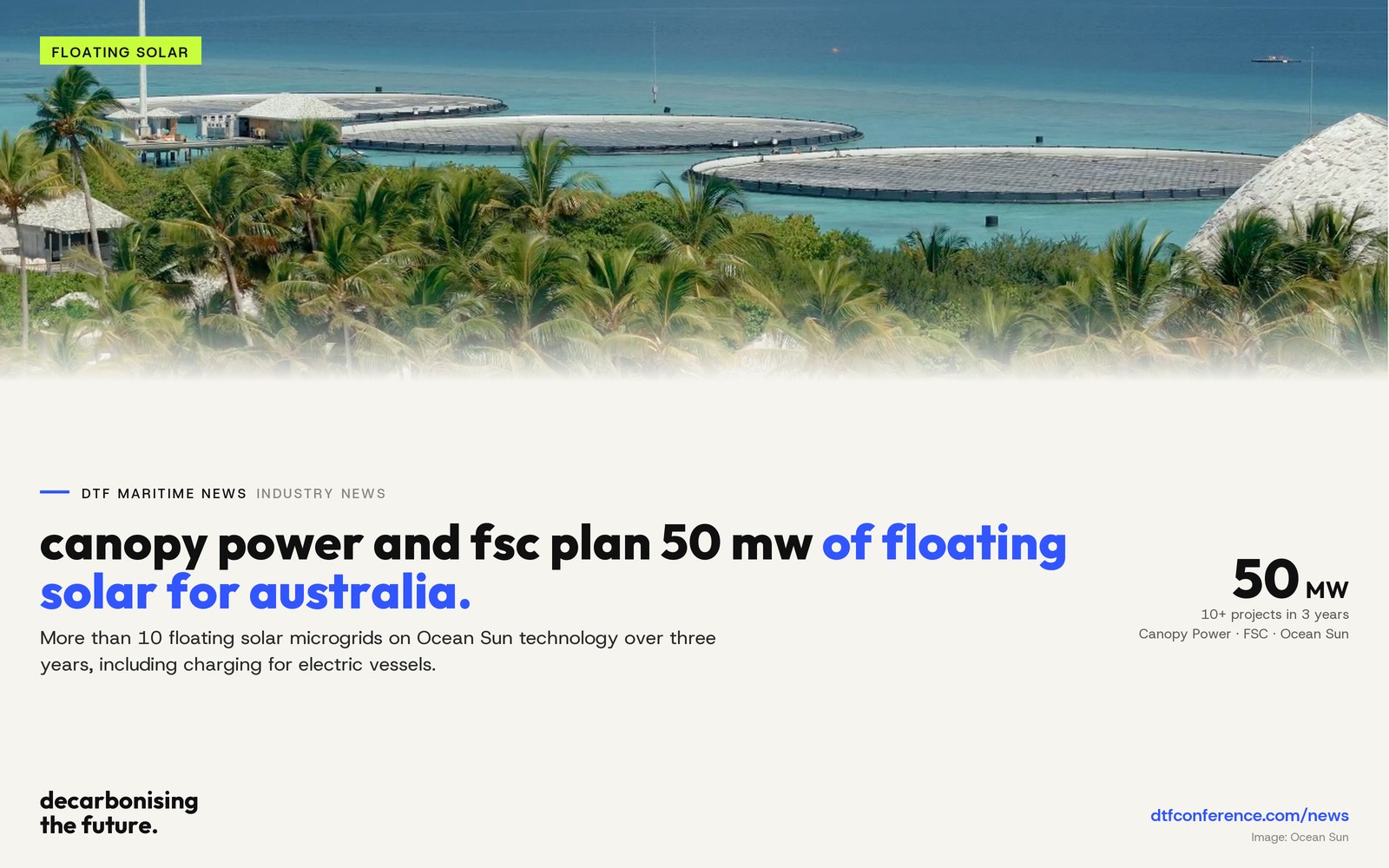
Floating solar is heading for Australia's reservoirs, ponds and small lakes. Microgrid specialist Canopy Power Australia and marine engineering firm Floating Solutions Consulting (FSC) have joined forces to deliver more than 50 MW of floating solar over the next three years, across 10 or more projects. The systems will be built on technology from Norway's Ocean Sun.
Construction of the first project is targeted for the second half of 2027. The pipeline is most advanced in Victoria, is growing in New South Wales, and other states are under review.
At a glance
| Canopy Power and FSC floating solar programme | |
|---|---|
| Partners | Canopy Power Australia and Floating Solutions Consulting |
| Technology | Ocean Sun floating membrane |
| Pipeline | 10 or more projects, about 50 MWp in total |
| Timeframe | 36 months |
| First construction | Second half of 2027 |
| Focus states | Victoria and New South Wales |
| Customers | Water utilities, data centres, mining and agriculture |
| Model | Custom floating solar microgrids with battery storage |
Who does what
The two companies split the job along its two disciplines. Canopy Power brings the energy side: solar microgrids and battery storage, with each floating array designed as part of a wider system that can add rooftop or ground mounted solar and wind where needed. FSC brings the marine engineering that keeps a floating structure moored, stable and working on the water for decades.
The partners are not chasing utility scale solar farms. Their market is commercial and industrial users who already own water: water utilities with ponds and reservoirs, farms with dams and small lakes, and mining and data centre sites.
The technology
- Membrane: modified silicon solar modules on a circular, 1 mm thick floating membrane, 70 metres across
- Size: about 700 kWp per ring, with rings combined for larger sites
- Cooling: the panels sit in direct thermal contact with the water, with Ocean Sun claiming up to 10% more yield than ground mounted or pontoon floating solar
- Strength: certified for winds up to 275 km/h
- Water benefits: up to 50% less evaporation, less algae growth and rainwater harvesting of about 2 million litres a year at a typical site
Why it matters for ports and vessels
The partnership also plans to bring floating charging stations to Australian waters for electric ferries, workboats and other electric vessels. That is where floating solar meets maritime electrification. Harbours, marinas and ferry terminals often have more water than land, and a grid connection that cannot easily take extra load. A floating array with batteries can generate power on site and charge vessels at the berth, cutting both diesel use and the need for costly grid upgrades.
Ocean Sun already runs floating arrays at sea, including at the Soneva Secret resort in the Maldives, shown above, so the step from reservoirs to sheltered harbour waters is a short one. For island ports and remote terminals in particular, local solar on the water could be the fastest route to charging electric ferries and workboats.
More on electric vessels and vessel charging is in Electric ferries and vessel charging.
Fifty megawatts on the water, built ring by ring, with the first ones in 2027.


