San Francisco Bay Ferry lays keel for first 5 MW ferry charging float
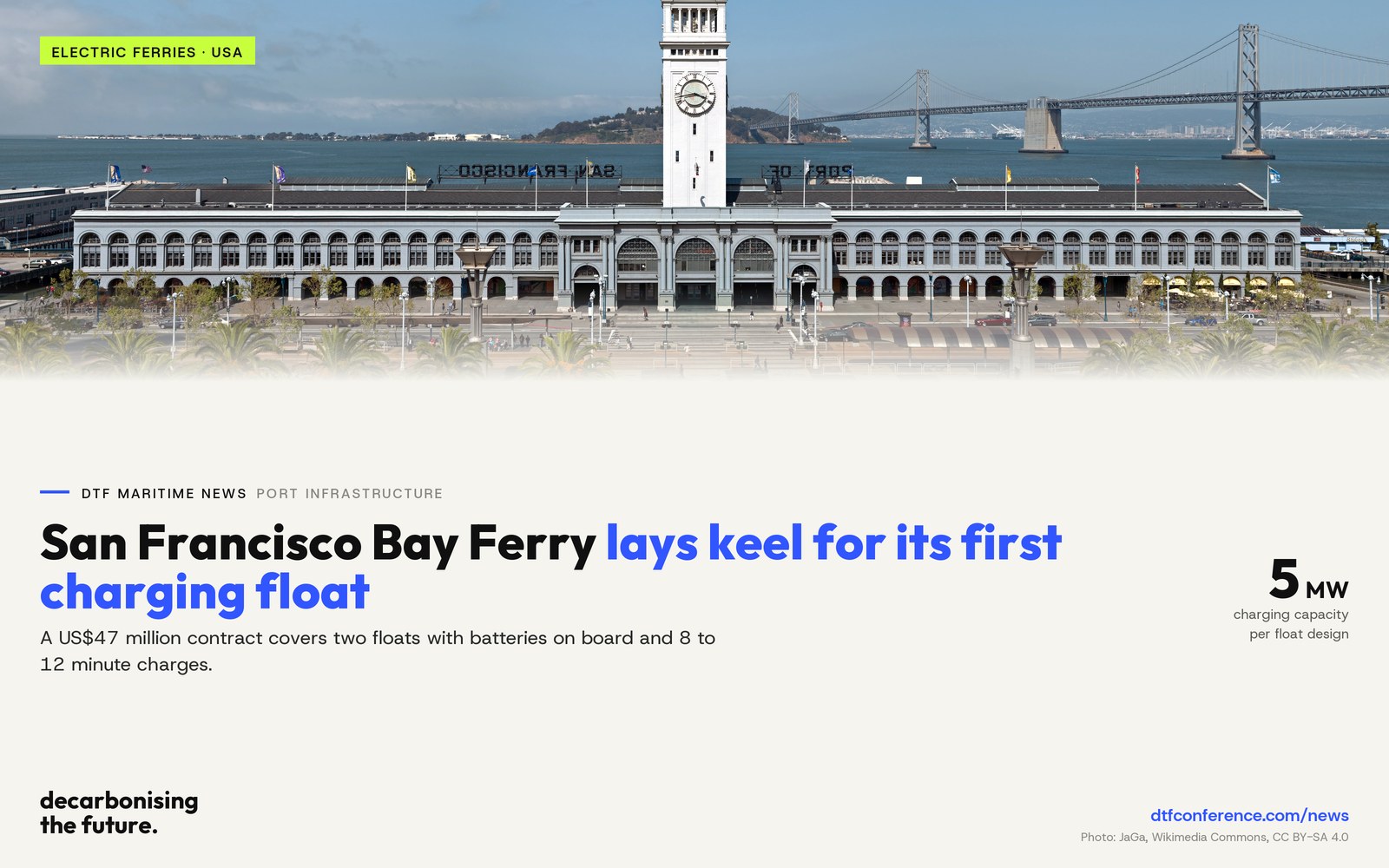
JT Marine has laid the keel for the first universal charging float for San Francisco Bay Ferry, operated by the San Francisco Bay Area Water Emergency Transportation Authority (WETA), a milestone marked in early November 2026. The float is the first of two covered by a US$47 million contract, and WETA's technical presentations describe the design with 5 MW of charging capacity and rapid charges of 8 to 12 minutes. Our guide to electric ferries and port charging explains why turnaround time drives this kind of design.
At a glance
| Topic | |
|---|---|
| Operator | San Francisco Bay Ferry (WETA) |
| Builder | JT Marine, Vancouver, Washington |
| Designer | Aurora Marine Design, San Diego |
| Contract | US$47 million, approved 9 October 2025, two floats with option for a third |
| Charging | 5 MW capacity, 8 to 12 minute rapid charge, 1,000 V DC |
| Storage | 1.5 MWh battery on each float |
| Sites | Downtown San Francisco Ferry Terminal Gate G, Alameda Seaplane Lagoon |
| Vessels | First battery electric ferries due in 2027 |
A charging station that floats
The float is part of WETA's Rapid Electric Emission Free (REEF) Ferry Program. It carries the power conversion equipment, battery storage and charging systems on the float itself, so ferries can charge while passengers board and leave. The footprint is comparable to the agency's existing passenger floats.
Putting the equipment on the float reduces what has to be installed aboard each ferry and limits work on shore. WETA says the battery storage on the float will lower peak power demand and operating costs. Installation at the terminals sits outside the shipyard contract and will be let under separate contracts.
The 5 MW figure
WETA's presentations to the California Energy Commission and to the ferry industry list the universal charging float at 5 MW of charging capacity, with a 1.5 MWh battery energy storage system. The figure describes the float design; WETA has not published a separate grid connection rating for each terminal.
The chargers use connectors based on the Megawatt Charging System (MCS) at 1,000 V DC. Larger vessels connect with four plugs and smaller vessels with two. Power arrives through a 12.47 kV switchboard and is stepped down by transformers on the float. The float is sized for the charging speed the 400 passenger REEF ferries need.
Contract and schedule
WETA's board approved the award to JT Marine unanimously on 9 October 2025, for US$47,033,608. The contract covers two floats with an option for a third. New floats go to Gate G at the Downtown San Francisco Ferry Terminal and to Alameda's Seaplane Lagoon terminal, while existing floats will be retrofitted for Harbor Bay and Mission Bay.
WETA's latest published schedule places the floats as follows:
- Float 1 at Gate G: second quarter of 2027
- Float 2 at Seaplane Lagoon: fourth quarter of 2027
- Gate G retrofit moved to Harbor Bay: second quarter of 2028
A smaller float mounted charging system is planned for Treasure Island in the first quarter of 2027.
The ferries that will plug in
Three 150 passenger battery electric ferries are under construction at All American Marine in Bellingham, Washington, with an option for a fourth. Two 400 passenger battery electric ferries are being built at Nichols Brothers Boat Builders in Freeland, Washington. The first vessels are due in 2027. WETA reports US$252 million secured for its zero emission transition.
Why it matters for ports
High power ferry charging usually collides with two limits: the time a vessel spends at the berth and the capacity of the local grid. A battery on the float addresses both, charging slowly from the grid between calls and releasing energy fast when a ferry docks. It is the same capacity question ports face with harbour charging for electric tugs.
The use of MCS based connectors also matters. A common plug standard across vessel classes lets one float serve different ferries, a step towards the interoperability seen at the first maritime MCS charging hub in Norway. Port grid and charging design will feature at DTF PortFocus Barcelona 2027.
San Francisco is building its ferry chargers as vessels in their own right, with the grid problem solved on the water.


