Italy cold ironing scorecard: Savona tests as €700 million port programme nears service
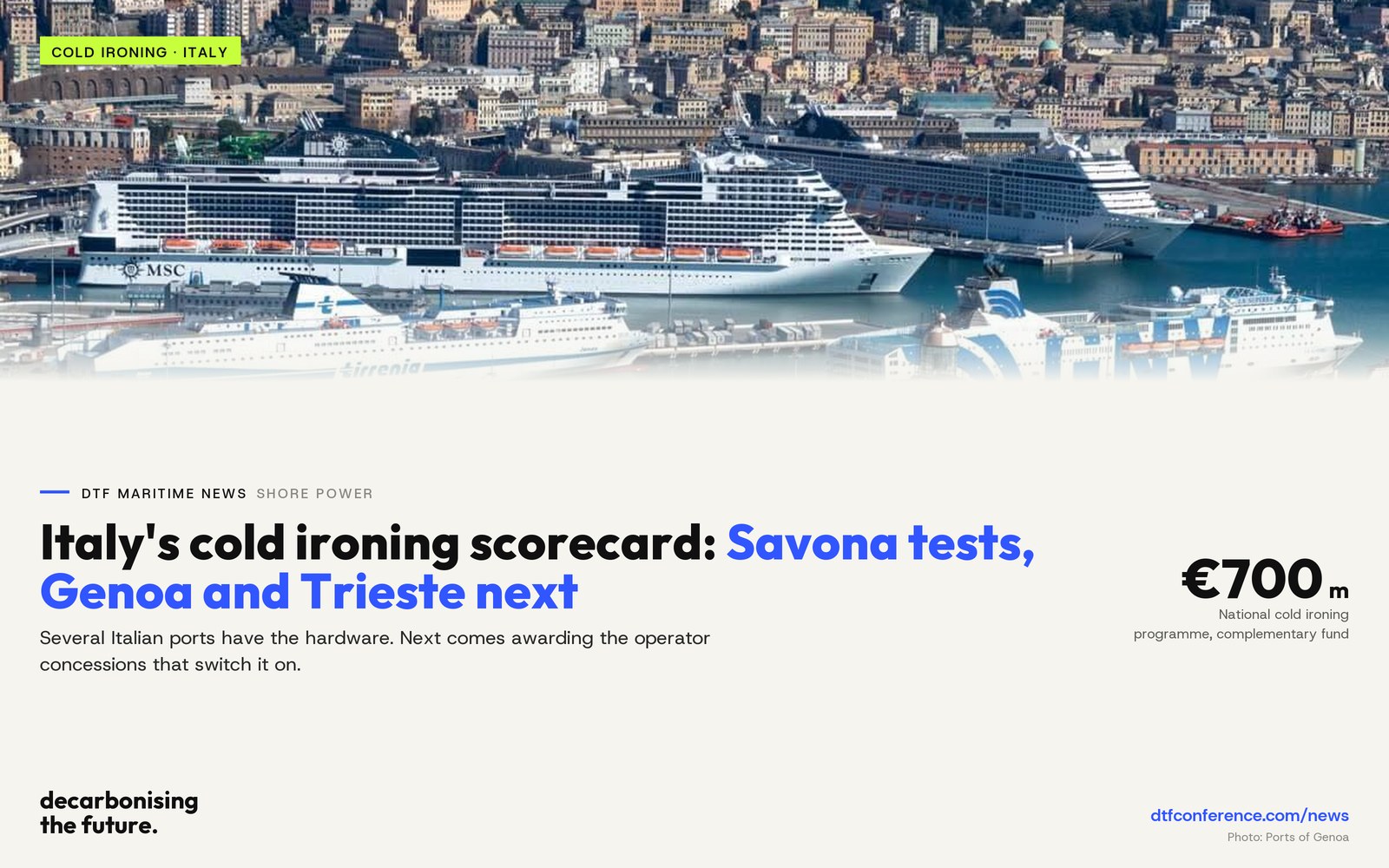
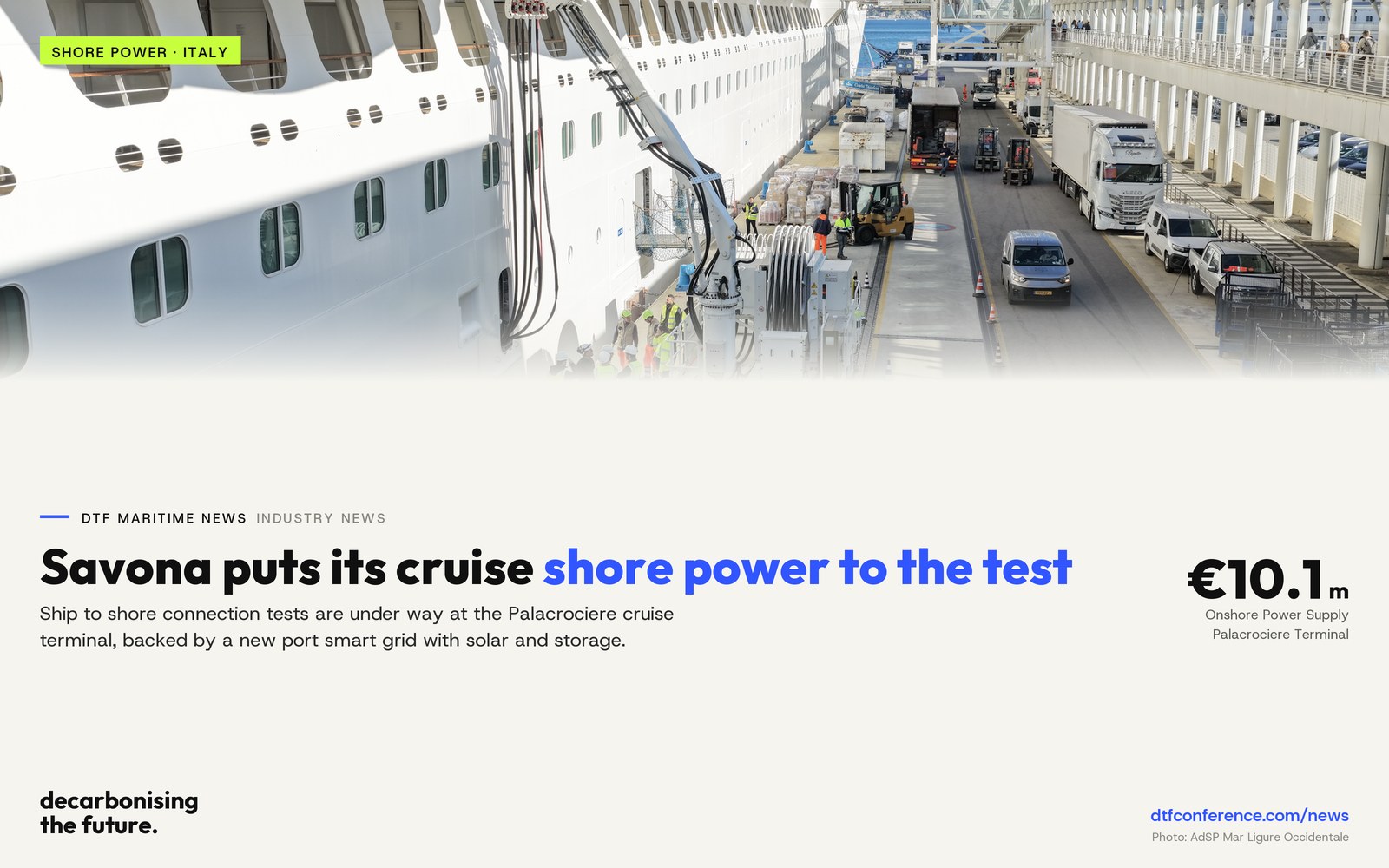
Italy's cold ironing programme reached the quayside in November 2026. At Savona, the Palacrociere cruise terminal completed its first ship to shore connection tests on a €10.1 million system, while La Spezia, Genoa, Trieste and the Tuscan ports move from construction to commissioning. The national effort rests on a €700 million cold ironing line in the complementary fund to the PNRR.
This scorecard covers the berths that port system authorities (AdSP) and the Ministry of Infrastructure and Transport (MIT) have documented. For the national rules and funding in Italian, see the DTF guide cold ironing nei porti italiani.
At a glance
| Topic | |
|---|---|
| National programme | €700 million, complementary fund (decree allocation €675.63 million) |
| EU approved power discount | €570 million, to 31 December 2033 |
| MIT decree | D.M. n. 10 of 22 January 2026 |
| Concession guidelines | Adopted by MIT in July 2026 |
| First cruise ship tests | La Spezia, October and December 2025 |
| Discount ends at main ports | 1 January 2030 |
Port by port: built, testing or live
| Port | Berths | Status | Funding |
|---|---|---|---|
| Savona | Palacrociere cruise berths | Works complete July 2026; dry run connection tests completed November 2026 | €10.1 million, PNRR and national programmes |
| Genoa | 6 cruise and ferry berths | Substation built; first cruise berth tests scheduled for second half of 2026; some ferry berths not before 2028 | €20 million project; PNRR funds redirected to Genoa and Savona cruise berths in June 2026 |
| La Spezia | Molo Garibaldi cruise berths, 10 MW available | Ship tests with MSC Seaview (October 2025) and Costa Toscana (December 2025); service planned from the 2026 season | Substation contract just over €7 million |
| Livorno, Piombino, Portoferraio | Cruise, ferry and container quays | Under construction | €77.5 million, PNRR and complementary fund |
| Civitavecchia | 9 berths: 3 cruise, 4 ferry, 2 multipurpose | Works began February 2025; completion scheduled for June 2026 | €81 million, PNRR |
| Trieste and Monfalcone | Molo Bersaglieri, Riva Traiana, Molo V, Molo VII, logistics platform, Monfalcone quay | Units installed; load bank tests at Molo V and Molo VII; operator tender planned by end 2026 | Over €46 million |
| Gioia Tauro | Eastern quay | Under way | €66 million: €48 million PNRR, €18 million AdSP |
Savona and La Spezia lead on cruise berths
Savona's mobile cable management unit, rated for cables up to 20 MVA at 11 kV, arrived in December 2025. The Western Ligurian Sea AdSP declared the works complete in July 2026, including a new substation, and is now moving to award management of the plant. The November tests were dry runs without live power.
La Spezia ran its first cruise ship test on 21 October 2025, when MSC Seaview connected at Molo Garibaldi using a cable robot the AdSP bought in Estonia. Costa Toscana completed the second phase on 18 December 2025. Terna is building a new 132 kV substation, La Spezia Stagnoni, for about €38 million, to raise total port capacity to 110 MW.
Genoa, Trieste and the Tyrrhenian ports
Genoa's passenger terminal scheme covers six berths and a 60 MW system designed to serve all cruise and ferry berths at once. In June 2026 an MIT decree moved PNRR money from a delayed ferry project to the Genoa and Savona cruise berths, bringing that funding to €32 million.
Trieste has installed its shore power units and is load testing two piers. MSC and DFDS have offered ships for trials, and the AdSP plans to tender the operator concession by the end of 2026. In Tuscany, cable ducts are largely laid at Livorno and Piombino, with conversion cabins under way.
Rules and tariffs: what MIT has set
The European Commission approved Italy's €570 million scheme on 17 June 2024. It cuts general system charges on shore side electricity by up to 100% until the end of 2033. D.M. n. 10 of 22 January 2026 put it into effect and requires the discount to reach shipowners and operators directly. From 1 January 2030 it can no longer be granted at the main ports.
MIT's July 2026 guidelines tell each AdSP how to tender the service:
- A public concession under Legislative Decree 36/2023, indicatively for 5 to 10 years.
- Tariffs built from four parts: a connection fee, an hourly charge, an energy charge and a charge on contracted power.
- Energy priced on an indexed, fixed (via a PPA) or hybrid basis; no numeric tariffs are set.
- Volume discounts and priority for island continuity services, with reviews at least every two years.
Why it matters for ports
Italy's bottleneck has moved from steel and cable to contracts. Several ports have hardware in place but no appointed operator, and no ship can buy power until one is. AFIR requires shore power for large passenger and container ships at TEN-T ports from 2030, and Trieste's AdSP has said the challenge is persuading owners to connect before then.
Read more on Savona's cruise shore power tests and Genoa's power plant plan for cold ironing. Mediterranean port electrification is on the agenda at DTF Malta 2027.
Italy has built the plugs. The 2027 test is whether the concessions switch them on.