Who maps the charger for the ferry? Half the industry says the port
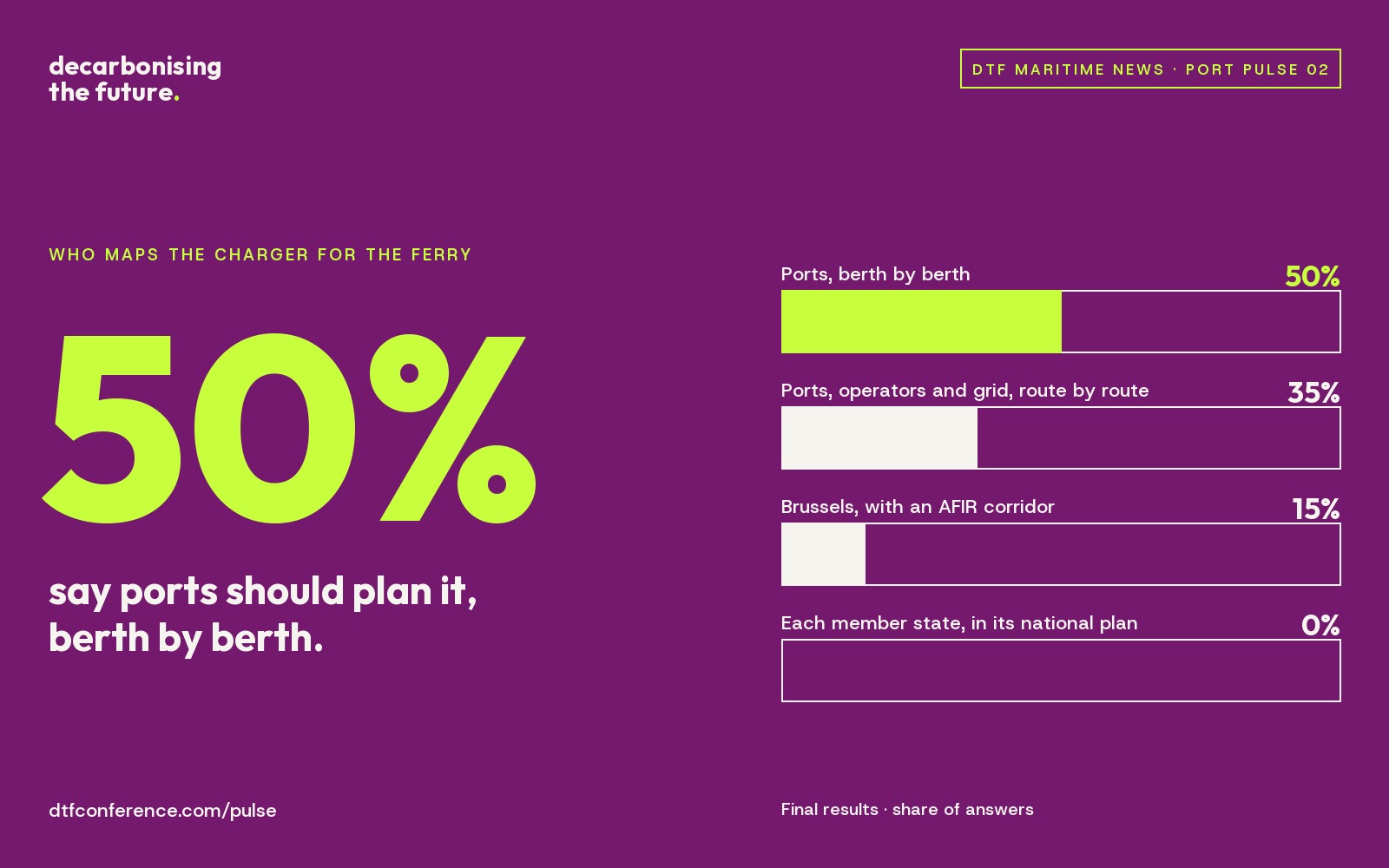
Half of the shore power professionals who answered DTF's Port Pulse say the port itself should plan where ferries charge, berth by berth. Not one voter chose the national plans that EU law relies on.
DTF closed the second edition of Port Pulse, its poll of the week, on 8 November 2026. The question was simple: Europe maps a charger every 60 km of motorway, so who should map the charger for the ferry? 50% answered ports, berth by berth. 35% said ports, operators and the grid together, route by route. 15% wanted Brussels to draw an AFIR corridor for ferries and waterways. Member states, through their national plans, got 0%.
Voters came from port and shipping agencies, energy and technology suppliers, universities, environmental organisations and international maritime bodies. See the charts on the Port Pulse 02 results page.
A road network, a port checklist
The question rests on a gap in the rulebook. AFIR, the Alternative Fuels Infrastructure Regulation, gives trucks and cars a network: charging pools at set distances along the main TEN-T corridors. For ships it sets targets port by port, and its shore power duty covers seagoing passenger and container ships above 5,000 gross tonnes. Most electric ferries on short crossings are smaller than that. Their chargers are planned by whoever owns the route or the quay. Our AFIR guide for ports sets out what the regulation does require.
The quay wins
The clear majority trusts the party that holds the berth and the grid connection. That matches how ferry charging is being built. In Norway, Plug opened a 2 MW charging hub with battery storage at Lysefjord for a new electric ferry. In California, San Francisco Bay Ferry has laid the keel for its first 5 MW charging float. Each project is designed around its own route and its own operator.
A route has two ends
The second answer, chosen by 35%, is the more demanding one. A ferry is not served by one charger. It needs power at both ends of the crossing, sized to its turnaround, and a grid able to deliver it. That makes it a joint plan between ports, operator and utility. Read with the first answer, 85% of voters put ports at the centre of the plan, alone or with partners.
The empty column
The most striking result is the one nobody picked. Under AFIR, each member state sets out its plans for alternative fuels infrastructure in a national policy framework. Not one voter chose that route for ferry charging. Brussels drew only 15%. The industry is not asking for a European ferry corridor. It is asking for the people at the quay to be given the means to build one.
Our guide to electric ferries and port charging explains how ships plug in. Ferry and cruise berths are on the programme at DTF PortFocus Barcelona on 24 and 25 February 2027.
Europe has a map for the motorway. For the ferry, the industry says the map starts at the quay.