Port of Los Angeles 2025 inventory: NOx lowest since 2005, 14% zero emission equipment
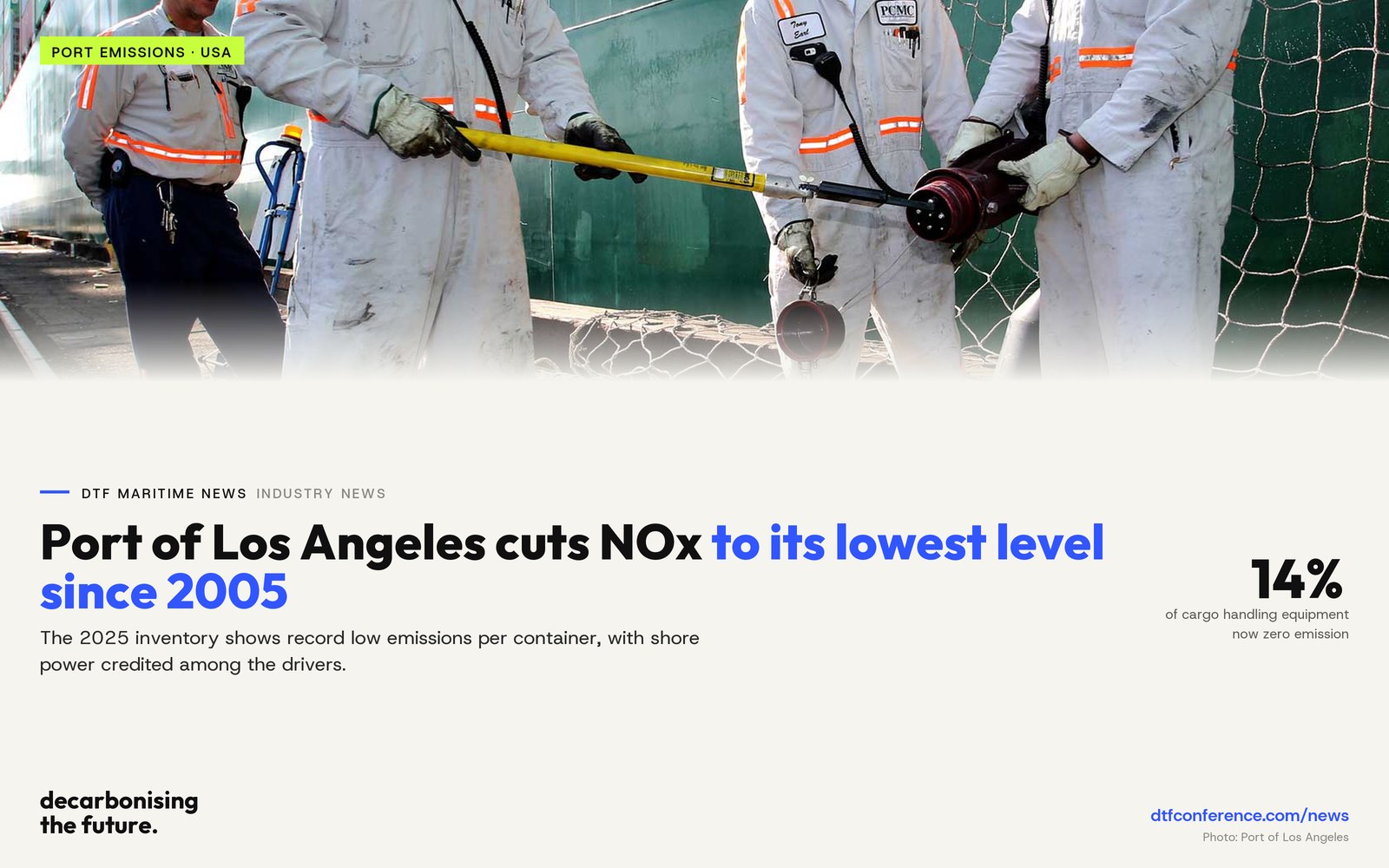
The Port of Los Angeles recorded its lowest emissions per container on record in 2025, according to its annual air emissions inventory released on 22 October 2026. The port handled nearly 10.2 million TEU, while nitrogen oxides (NOx) fell to their lowest annual total since tracking began in 2005. The port credited shore power among the drivers; our shore power guide explains how at berth power cuts ship emissions.
At a glance
| Topic | |
|---|---|
| Report | 2025 Inventory of Air Emissions, released 22 October 2026 |
| Throughput | Nearly 10.2 million TEU, up 37% since 2005 |
| Since 2005 | Diesel particulate matter down 90%, NOx down 72%, SOx down 98%, greenhouse gases down 16% |
| 2025 vs 2024 | DPM down 2%, NOx down 4%, SOx down 5%, greenhouse gases down 3% |
| Cargo handling equipment | Electric units up 20% in 2025; zero emission units 14% of the fleet |
| Harbour craft | 55% meet Tier 3 or Tier 4, up from 20% in 2017 |
| Shore power | 80 vaults; all cruise and container berths equipped |
Twenty years of falling emissions
The 2025 inventory covers calendar year trade activity and marks 20 years of the San Pedro Bay Ports Clean Air Action Plan. Against the 2005 baseline, diesel particulate matter (DPM) is down 90%, NOx 72%, sulphur oxides (SOx) 98% and greenhouse gases 16%, while container volumes grew 37%.
Since the plan's 2017 update, DPM is down 15%, NOx 38%, SOx 28% and greenhouse gases 9%. The port reports that emissions efficiency improved for every pollutant compared with 2024, 2017 and 2005, and that it continues to meet the plan's 2023 standards of 77% lower DPM, 59% lower NOx and 93% lower SOx.
Terminal equipment and harbour craft
The number of electric cargo handling units rose 20% in 2025. Zero emission machines now make up 14% of all cargo handling equipment at the port, and hybrid units are ten times the 2017 count. Cargo handling equipment emissions are down 83% for DPM and 87% for NOx since 2005.
In the harbour craft fleet of tugs, barges, ferries and work boats, 55% of vessels met Tier 3 or Tier 4 engine standards in 2025, against 20% in 2017 and none in 2005. Trucks also improved sharply, with DPM down 16% and NOx down 25% on 2024.
Ships and shore power
Ocean going vessels remain the largest source, accounting for about 43% of the port's fine particulate matter (PM2.5) and 54% of its NOx in 2025. Even so, ship DPM is down 94% and ship NOx 58% since 2005, and ship arrivals have fallen 34%.
The port named shore power as a driver of that progress. Its West Basin Container Terminal at Berth 100, opened in June 2004, was the first container terminal in the world to use shore power for container ships, under the port's Alternative Maritime Power (AMP) programme. It now has 80 AMP vaults, which it says is more than any other port, with every cruise and container berth equipped. California's at berth regulation requires container, cruise and reefer vessels to use grid power or an approved alternative, with auto carriers and tankers phased in from 2025.
Why it matters for ports
The inventory shows what a long running plan with a fixed baseline can deliver: steady falls across five source categories while cargo grew. It also shows where the remaining work sits. Greenhouse gases are down 16% since 2005, while the 2017 plan targets cuts of 40% below 1990 levels by 2030 and 80% by 2050, alongside zero emission terminal equipment by 2030 and zero emission drayage trucks by 2035.
Terminal equipment is the clearest test. At 14% zero emission, the fleet has a long way to go before 2030, which puts battery and cable reel options such as modular battery RTG crane electrification in focus. On the waterside, shore power programmes on the US East Coast are following a similar path, as at the Manhattan Cruise Terminal. Port emissions and shore power will be discussed at DTF Malta 2027.
Los Angeles has cut NOx to a 20 year low; the next test is zero emission terminals by 2030.