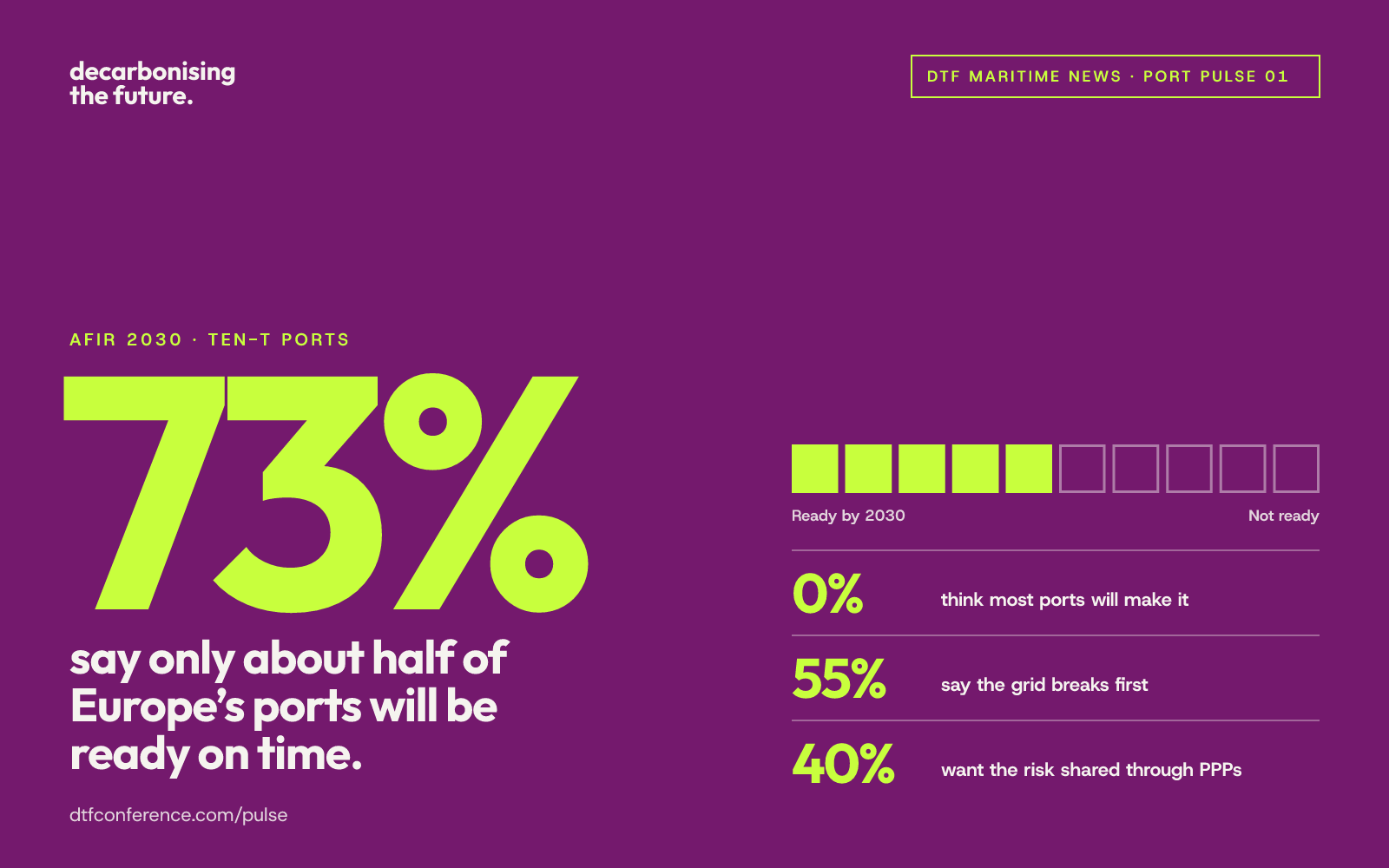
73% said only about half. The rest said fewer than half. Not one voter said most ports would make it.
Port Pulse 01 at a glance
- How many TEN-T ports will be ready on time for AFIR 2030? About half 73%, fewer than half 27%, most of them 0%
- When ships plug in, what breaks first? Grid capacity 55%, the business case 36%, permitting 9%, ship readiness 0%
- Who should carry the risk? Shared through PPPs and guarantees 40%, utilities and grid operators 25%, shipowners through tariffs 20%, port authorities 15%
Insiders are not pessimists
Half sounds gloomy. Against the inventory it looks optimistic. By one count across the Commission's TEN-T corridor work plans, published on 30 September, the network needs roughly 870 shore power connections and about 110 are in place. That is one in eight, with little more than three years to go.
The gap is not spread evenly. On the same count, the Mediterranean corridor has 8 of 117 identified connections, and the North Sea to Mediterranean corridor 13 of 142. A handful of northern ports, in Scandinavia and Belgium, are well advanced. Most of the south is not.
The likely outcome is not a Europe that fails together. It is a two speed Europe, in which ships plug in at Oslo and Gothenburg and run their generators at the quay further south.
A deadline without a penalty
Why would informed people expect a legal deadline to be missed by half? Because the cost of missing it lands on almost nobody.
AFIR binds member states, not individual ports. Enforcement runs through the Commission's infringement procedure, which takes years. FuelEU Maritime, meanwhile, requires ships to plug in only where a socket exists. A ship calling at a port without shore power is excused. The obligation on the ship is real; the obligation on the berth is political.
That asymmetry explains a striking result. Not one voter picked ship readiness as the weak link. Shipowners have been fitting sockets for years, and the order book shows they are still buying: container lines placed shore power orders worth about €15 million with a single supplier this summer alone. The fleet is getting ready. The quays are the bottleneck.
The grid, not the plug
A majority, 55%, said grid capacity breaks first. That matches what is happening in procurement. Ports increasingly buy the grid as a separate contract from the shore power equipment. Barcelona awarded its 25 kV network in June 2026 as the last piece needed to feed shore power it had already bought. Rotterdam's flagship order, 35 connection points across three container terminals, is due in the second half of 2028. HaminaKotka's six container berths are scheduled for August 2028.
Those are the leaders, and they finish with months to spare. For a port that has not yet secured a high voltage connection from its utility, the queue for substations and transformers alone can outlast the deadline. Ports now compete for grid capacity with data centres, electric trucking and industry. Shore power is a large, intermittent load that the grid has to be built for, and it earns money only when a ship is alongside.
Who pays
That last point is the business case, which 36% named as the first thing to break. A berth may host a cruise ship for a few dozen days a year. The equipment, the substation and the grid reinforcement are paid for every day.
Asked who should carry that risk, the industry gave a clear answer: not anyone alone. 40% chose shared risk through public private partnerships and guarantees. Utilities followed at 25% and shipowners through tariffs at 20%. Port authorities on their own were the least popular choice, at 15%.
The market is already moving that way. Italy now requires an operator concession before cold ironing can be sold. In Spain, an energy company has applied for a 35 year shore power concession at Santander. In Malta, the latest shore power agreement signed at DTF 2026 covers the electricity, not the equipment. The model is shifting from ports buying kit to operators selling power, with someone else holding the risk.
Brussels' choice
The Commission is due to review AFIR. It has three options. It can hold the line and let infringement cases do the work after 2029. It can grant flexibility, formally or by looking away, which rewards the laggards and penalises ports that invested early. Or it can pay to close the gap, with guarantees and grid funding aimed at the ports furthest behind.
The industry's own answers point to the third. A sector that expects half the network to miss the deadline, blames the grid and wants the risk shared is not asking for more time. It is asking for a financing structure that makes the investment worth doing.
What to watch
- The AFIR review. Any move on deadlines or exemptions will show whether 2029 is a deadline or a target.
- Grid contracts. Ports that have signed their high voltage connection by mid 2027 can still make it. Those that have not almost certainly cannot.
- Concessions. Italy's first operator tenders, starting with Trieste, will test whether private operators will take the utilisation risk.
- The south. The Mediterranean holds most of Europe's cruise calls and most of its gap. That is where the deadline will be won or lost.
Europe has set the date and the ships are getting ready. What it has not settled is who pays for the grid, and until it does, half the network is the honest forecast.