AFIR review: six areas Brussels is weighing as ports face 2029 shore power rules
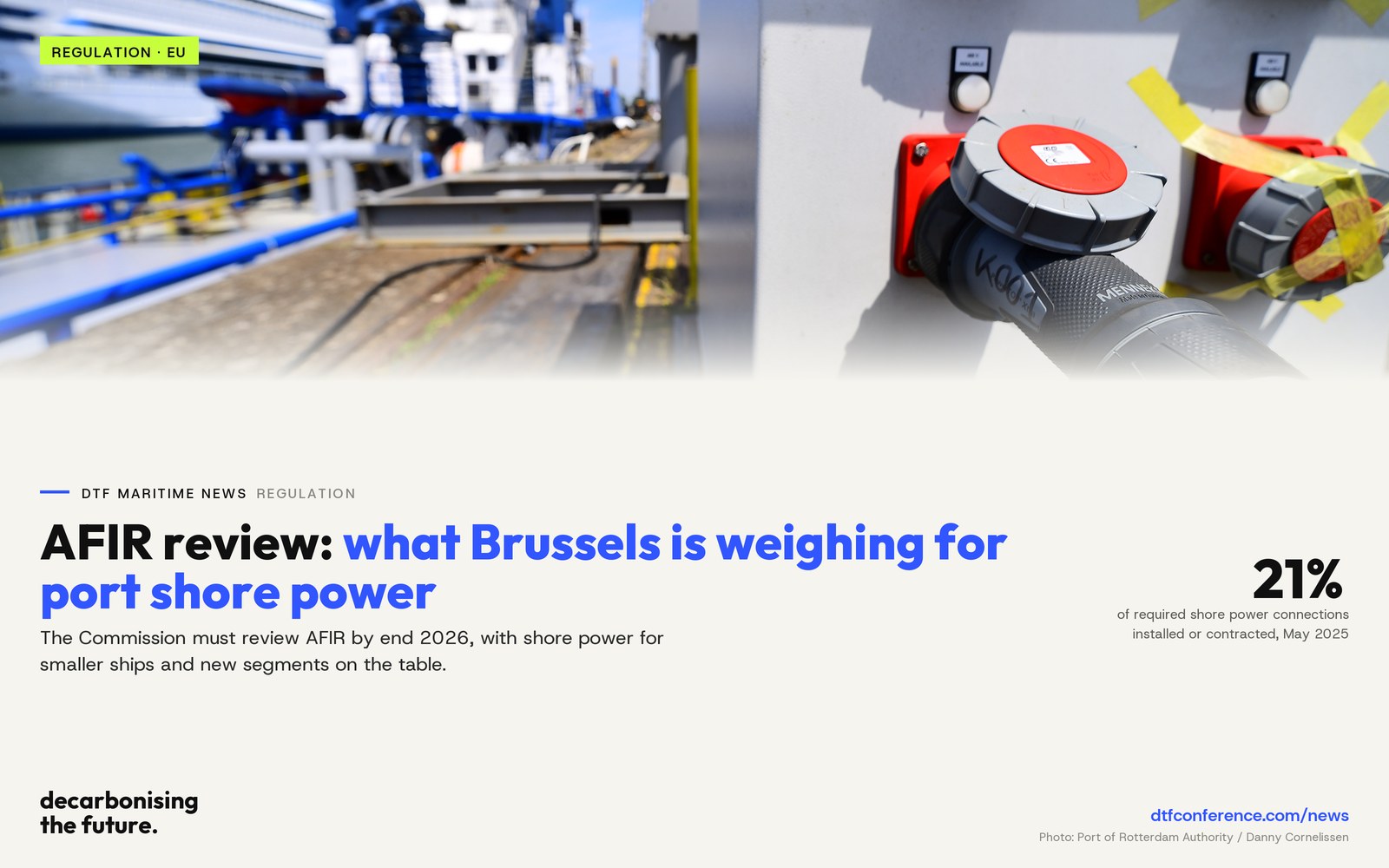
The European Commission must complete its review of the Alternative Fuels Infrastructure Regulation, Regulation (EU) 2023/1804, by 31 December 2026. A call for evidence ran from 23 March to 20 April 2026, a public consultation was launched on 12 May 2026, and the Commission's impact assessment covers six areas, one of them measures to accelerate alternative fuels infrastructure for shipping.
For ports, the question is whether the shore power rules agreed in 2023 will be widened before most of the current obligations are even built. Our AFIR guide for ports sets out the existing rules in full.
At a glance
| Topic | |
|---|---|
| Regulation | AFIR, Regulation (EU) 2023/1804 |
| Review deadline | 31 December 2026 (Article 24) |
| Call for evidence | 23 March to 20 April 2026 |
| Public consultation | Launched 12 May 2026 |
| Current shore power deadline | 31 December 2029 |
| Ships covered today | Container and passenger ships over 5,000 GT |
| Readiness, May 2025 | 21% of required connections at 31 EU ports |
What Article 9 requires today
Under Article 9, TEN-T core and comprehensive seaports must provide shore power for at least 90% of calls by seagoing container ships and passenger ships above 5,000 GT by 31 December 2029. The duty applies where traffic passes set thresholds: an average of more than 100 container ship calls a year over three years, more than 40 for RoRo passenger ships and high speed passenger craft, and more than 25 for other passenger ships, including cruise.
Ports on islands or in outermost regions without a connection to a mainland grid are exempt until such a link exists or enough local non fossil generation is available. Article 24 already tells the Commission to consider lowering the gross tonnage threshold and extending the rules to other ship types.
What the Commission is assessing
A background paper prepared for the European Parliament's Transport Committee states that the impact assessment covers six areas, including measures to accelerate infrastructure for shipping and aviation, with a focus on future technologies and fuels. The same paper warns that planning for maritime shore power risks running behind schedule in some Member States.
The public consultation asks whether additional targets are needed for maritime and inland waterway propulsion, naming electricity, hydrogen, ammonia and methanol. The earlier call for evidence listed a possible extension of the shore side electricity provisions as one of its focus areas.
What stakeholders have put on the table
- Transport & Environment (briefing, April 2026): extend the mandate to ships of 400 to 5,000 GT, which it estimates produce 30% of in port emissions; bring in RoRo, service and offshore vessels by 2030, bulk and general cargo ships by 2035 and tankers by 2040; require battery charging by 2030 where battery electric traffic justifies it; define port terminals and require port authorities and terminals to cooperate; and remove the Article 11 liquefied methane bunkering requirement.
- Eurelectric (paper, August 2026): targets alone are not enough for shipping. It wants coordination plans between ports and distribution system operators, tariff transparency, rules on how grid upgrade costs are shared, non discriminatory supplier access, and port deployment synchronised with ship obligations under FuelEU Maritime.
- World Shipping Council (response, April 2026): describes shore power as a critical part of maritime decarbonisation and says its members are retrofitting existing ships for shore power and planning new builds with the capability.
Why it matters for ports
The current mandate is far from built. Across 31 EU ports tracked by Transport & Environment, 93 of 448 required connections, or 21%, were installed or contracted by May 2025, and only 11% of container ship connections. Any extension to smaller ships or new segments would land on ports still working to deliver the 2029 obligation.
There is a utilisation case for widening the scope. Transport & Environment argues that serving smaller vessels at berths already equipped would raise use of the assets and improve returns. Eurelectric's point is the counterweight: without grid planning and cost rules, wider targets risk becoming more deadlines on paper. Ports should expect the review to deal with who is responsible at the terminal, not only how many connections are required.
What happens next
Once the review is complete, the Commission will consider whether to accompany it with a proposal to amend the regulation. Any change to Article 9 would then pass through the European Parliament and the Council, so the 2029 deadline stays in force for now.
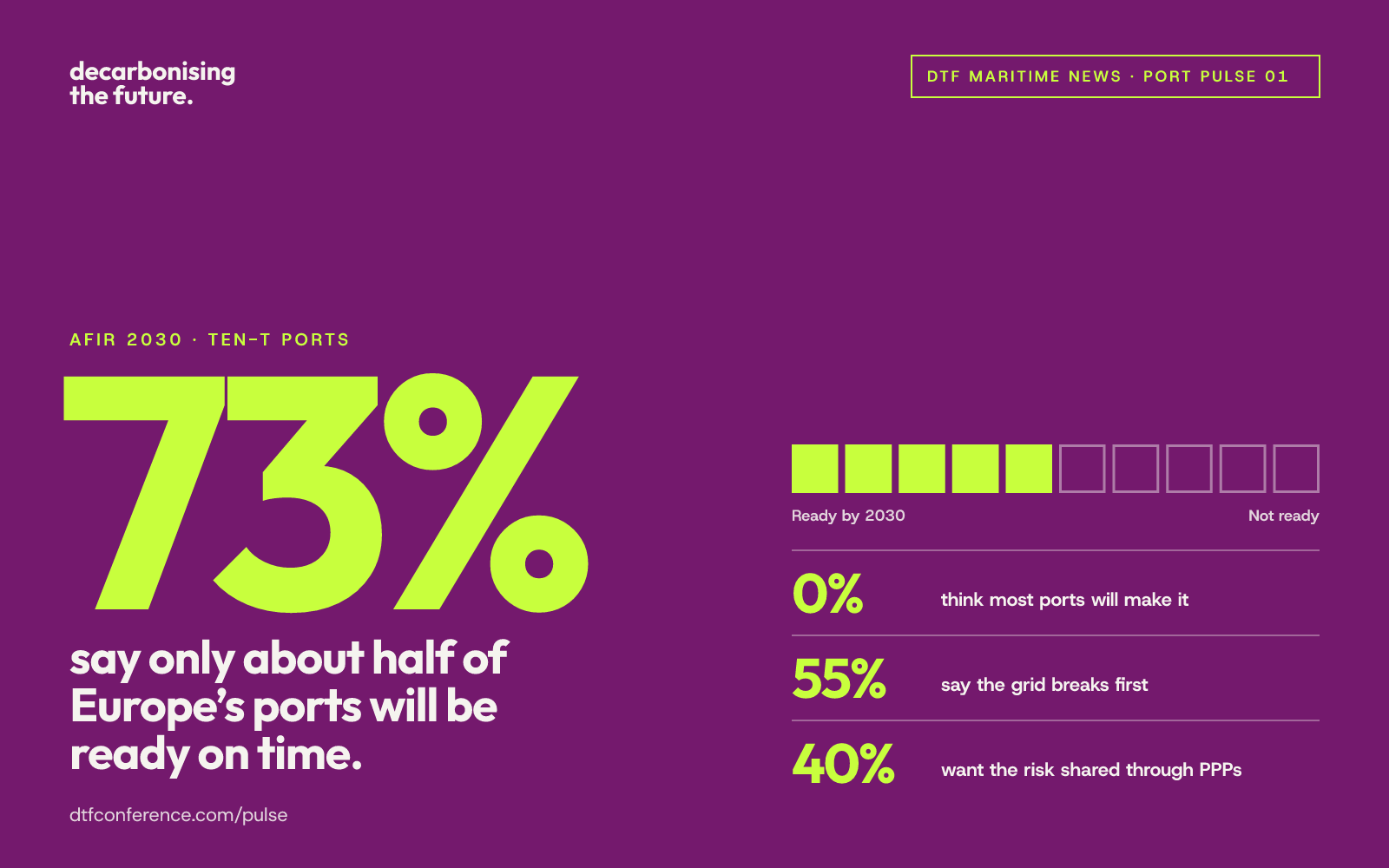
Read more from DTF: our Port Pulse on the credibility of the AFIR 2030 deadline and who carries the risk when Europe's ports plug in. The AFIR review is on the agenda at DTF Malta 2027.
The review will decide how wide AFIR reaches. The grid will decide whether it gets built.