Shore power tax: at least eight EU states cut electricity tax for ships at berth
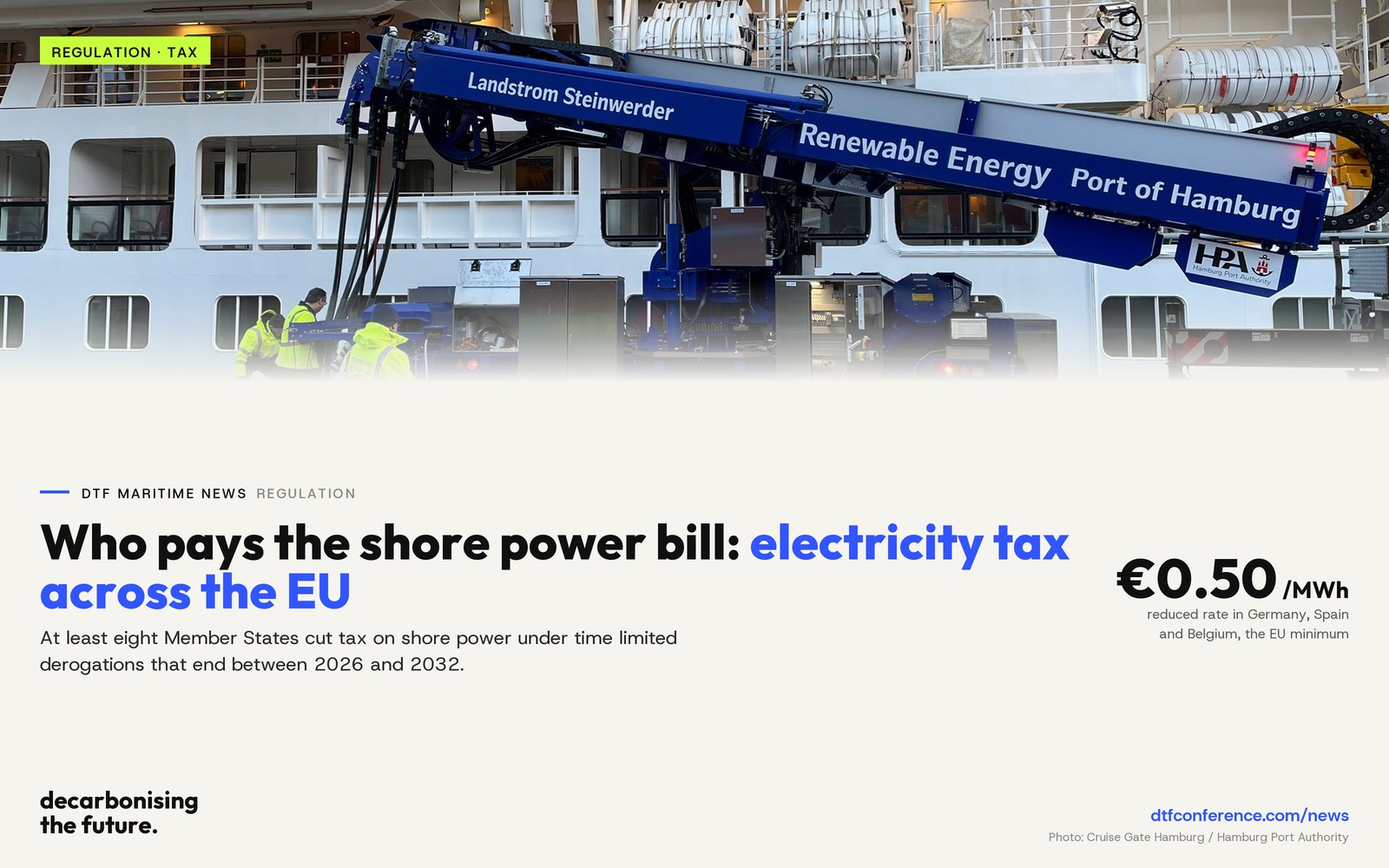
Electricity generated on board a ship is exempt from energy tax under the EU Energy Taxation Directive. Electricity supplied from the shore is not. At least eight Member States have narrowed that gap with time limited Council derogations, most recently Germany, authorised on 25 June 2026 to keep its reduced rate of €0.50 per MWh until 31 December 2029.
The result is a patchwork of national rates and expiry dates, and a tax relief that reaches the ship only through the tariff charged by whoever runs the installation. From 2030, FuelEU Maritime requires container and passenger ships above 5,000 GT to use shore power at berth in covered ports, so our FuelEU Maritime guide explains why that tariff will soon matter to every liner and cruise operator.
At a glance
| Topic | |
|---|---|
| Legal basis | Directive 2003/96/EC, Article 19 |
| Approval | Unanimous Council decision on a Commission proposal |
| EU minimum rate | €0.50 per MWh, business electricity |
| Germany | €0.50 per MWh against €20.50 standard, to 31 December 2029 |
| Belgium | €0.50 per MWh, 1 January 2027 to 31 December 2032 |
| Netherlands | €0.01121 per kWh in 2026, derogation to 30 June 2027 |
| Next expiry | France, 31 December 2026 |
Why shore power is taxed at all
Article 14(1)(c) of the directive exempts fuel used for navigation in EU waters, other than in private pleasure craft, and electricity produced on board. Electricity bought from the grid for a ship at berth has no equivalent exemption.
A Member State that wants a lower rate must request a Commission proposal under Article 19 and secure a unanimous Council decision. Each authorisation is limited in time, to a maximum of six years, and must respect the EU minimum of €0.50 per MWh for business use.
Who has a derogation, and until when
- France: Decision (EU) 2020/1629, from 1 January 2021 to 31 December 2026.
- Denmark: Decision (EU) 2021/922, from 18 June 2021 to 17 June 2027.
- Netherlands: Decision (EU) 2021/921, from 1 July 2021 to 30 June 2027. The reduced energy tax rate has applied since 1 October 2021 and is €0.01121 per kWh in 2026, against €0.09161 per kWh in the lowest consumption bands.
- Sweden: Decision (EU) 2024/837, from 1 January 2024 to 31 December 2027.
- Italy: Decision (EU) 2021/2058, from 1 January 2022 to 31 December 2027.
- Spain: Decision (EU) 2025/210, €0.50 per MWh to 31 December 2028, two years short of the 2030 end date Spain first requested.
- Germany: renewed in June 2026 at €0.50 per MWh against a standard rate of €20.50, to 31 December 2029.
- Belgium: Decision (EU) 2026/1776, adopted on 10 July 2026, €0.50 per MWh from 1 January 2027 to 31 December 2032.
Who actually pays
The reduced rate applies to electricity delivered to the shore power installation, so the relief lands with whoever holds the grid connection: a port authority, a terminal operator or a specialist operator. In Germany, 28 companies claimed it in 2024 on about 74,100 MWh, at a revenue cost of about €1.48 million. Belgium will require operators to declare which grid connections serve only qualifying installations.
The shipowner meets the tax only inside the tariff charged at berth, bundled with network charges and the operator's cost recovery. That is why Eurelectric asked for tariff transparency and clear rules on grid upgrade costs in its paper on the AFIR review. A tax cut that is not passed through does not change the comparison a ship makes against running its auxiliary engines.
The EU wide fix is stalled
The Commission's 2021 recast of the directive, COM(2021) 563, would let every Member State exempt or reduce tax on shore side electricity without a separate Council decision. ESPO and FEPORT have called for a mandatory and permanent EU wide exemption instead. Ministers failed to reach the unanimity needed for a general approach at ECOFIN on 13 November 2025, and the European Parliament's legislative tracker listed the file as blocked in October 2026.
Why it matters for ports
Every national derogation lapses if general EU rules are adopted, and none runs longer than six years. Belgium's is the only one that reaches past the 2030 connection mandate, while France's ends on 31 December 2026. Ports negotiating multi year berth and supply contracts should check the end date in their own Member State before fixing a tariff.
Belgium also shows the order of events changing. It has no maritime shore power installations today, expects about 40 by 2030 and about 70 by 2035, and secured its tax relief before the first one is built.
Related reading from DTF: who carries the risk when Europe's ports plug in and funding the ports that will power Europe's energy transition. Shore power pricing is on the programme at DTF Malta 2027.
Until the directive changes, the tax on a ship's power at berth depends on where it docks and in which year.