Cruise lines and shore power: 193 ships can plug in, but only 40 ports can supply them
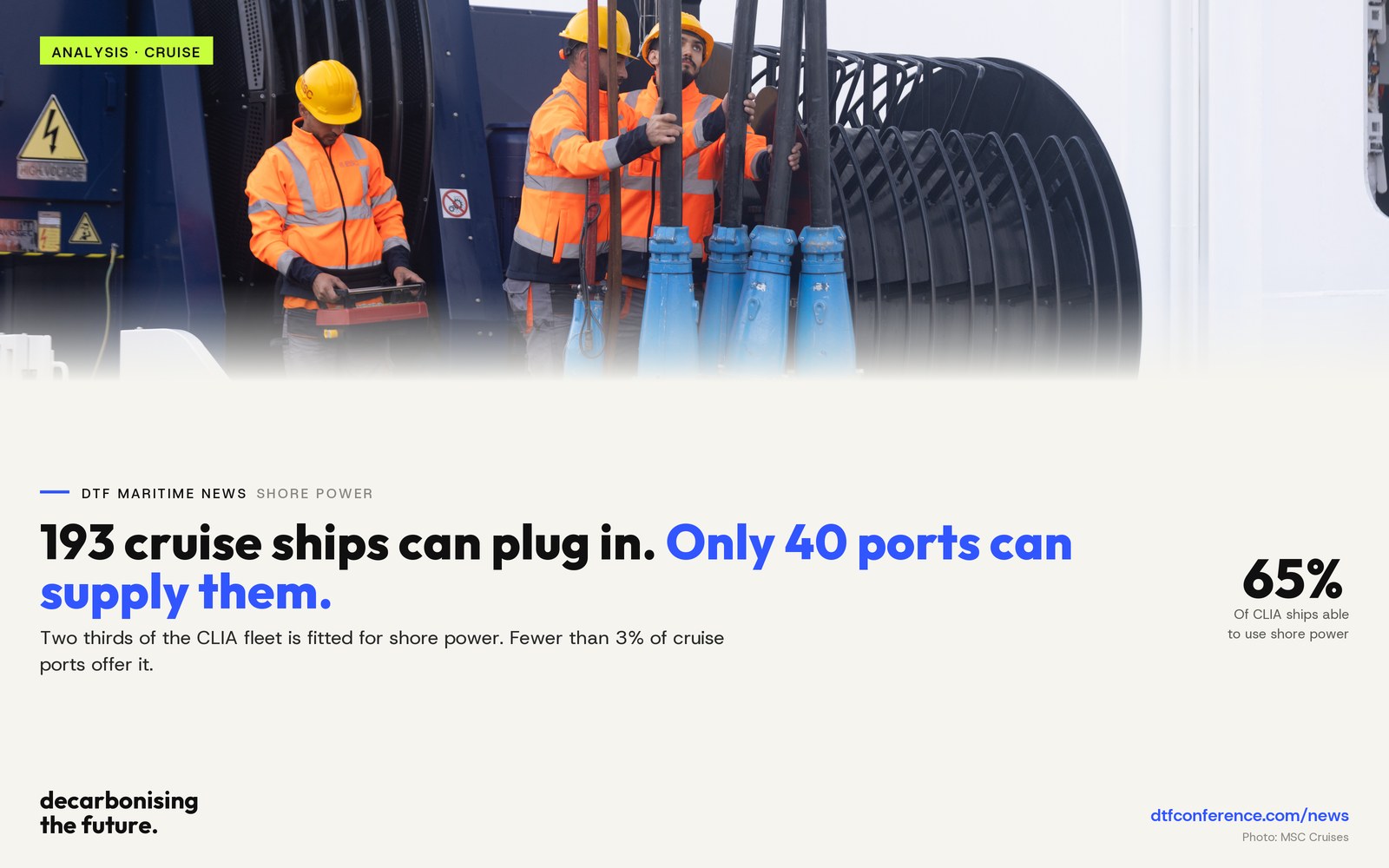
Do cruise ships connect to shore power? Most of them can. CLIA's environmental technologies report of 16 September 2026 counts 193 member ships able to plug in, 65% of reporting ships and 72.5% of capacity. The limit is the quay: only 40 ports worldwide have at least one cruise berth with shore power, under 3% of the ports cruise ships visit.
The ship side has moved fast. In 2018 just 55 CLIA ships could connect. For how the connection works on the berth, see the DTF shore power guide.
At a glance
| Topic | |
|---|---|
| Ships able to connect | 193 (55 in 2018) |
| Share of CLIA fleet | 65% of ships, 72.5% of capacity |
| Retrofits planned | 47 ships |
| Newbuilds specified | 39 ships |
| Projected by 2039 | 279 ships, about 74% of ships and 82% of capacity |
| Ports with cruise shore power | 40 worldwide |
What the cruise groups report
The groups publish on different dates and bases, so the table gives each company's own latest stated figure and the period it refers to.
| Cruise group | Ships fitted | Target |
|---|---|---|
| MSC Group Cruise Division (MSC Cruises, Explora Journeys) | 18 of 25 ships (October 2025) | Standard on all new MSC Cruises ships since 2017; retrofits under way |
| Carnival Corporation & plc | 68% of fleet (end of Q2 fiscal 2024) | 80% by 2030; earlier 2030 goal met in 2023 |
| Royal Caribbean Group | 50% of ships by end of 2025 (company plan) | All new ships built with shore power; retrofits continuing |
| Norwegian Cruise Line Holdings | 19 ships, about 59% (FY2024 annual report) | About 70% by year end 2025 |
| TUI Cruises (Mein Schiff, Hapag-Lloyd Cruises) | 8 of 11 ships (end of 2023) | Whole fleet by 2030 |
| Hurtigruten (Norwegian coastal service) | All 7 ships (2021) | Fleet already fitted |
Carnival's figure covers brands including AIDA, Costa, Cunard, Holland America, P&O Cruises and Princess. NCLH's latest annual report, for 2025, does not restate a fleet share, so the 2024 filing is the most recent company figure.
Capability is not the same as connection
Fitted ships only cut emissions where a berth can supply them. MSC Cruises made 142 connections in 13 ports in 2024, more than triple the year before. Carnival lists 22 ports where its ships have connected, from Juneau and Seattle to Hamburg, Kiel, Bergen and Shanghai, and says it has more ships ready to plug in than there are ports able to supply them.
TUI Cruises drew 1,310,816 kWh of shore power in 2023, up from 451,910 kWh in 2022. Royal Caribbean Group reported that shore power at PortMiami, California and Vancouver cut port emissions by about 5,000 tonnes of CO2e in a year, and has capacity agreements for Ravenna in 2026 and Barcelona in 2027.
The port gap
CLIA's 2025 report said 19 more ports had secured funding for cruise shore power and 26 had plans. It also noted that shore power can cut in port emissions by up to 98%, depending on the local energy mix.
Regulation will close part of the gap. Under AFIR and FuelEU Maritime, EU TEN-T core and comprehensive ports above set traffic thresholds must supply shore power to large passenger ships from 2030, and those ships must use it. Outside Europe, provision depends on port and state funding programmes.
Why it matters for ports
Demand is no longer the open question. With roughly two thirds of the CLIA fleet fitted and 39 more newbuilds specified for it, a port that builds a cruise berth with shore power can expect ships able to use it. The commercial risk sits in grid capacity, tariffs and utilisation, not in whether the lines can plug in.
Read more on MSC's cruise division and shore power and Carnival's early emissions target. Cruise port electrification is on the agenda at DTF Malta 2027.
Two thirds of cruise ships can plug in. Fewer than one cruise port in thirty can take the cable.